Chief Inspector’s Annual Report 2025-2026
Our annual report outlines our work throughout 2025-2026.
1. Summary
This year’s report shows social care and childcare and play systems delivering many positive outcomes, but under sustained pressure.
1.1 What is happening across the system
- Quality is generally strong. In adult services and children’s care homes, 90% of ratings were good or excellent. In childcare and play, 80% of ratings were good or excellent. This shows most services are delivering safe, compassionate and effective
care. - Provision is changing shape. Domiciliary support, children’s care homes and full day care continue to grow, while some care home provision, childminding and sessional childcare are reducing. Capacity is largely being maintained, but not always in the forms of care and childcare people and families need most.
- Improvement is happening, but pressure points remain. Where we found poor care, leadership and management remained the most common weakness, often linked to staffing, governance, oversight, records, safeguarding and medication.
- Local authorities show strong practice, but consistency varies. We saw person-centred, rights-based and preventative approaches, but timeliness of assessments, safeguarding communication, placement sufficiency and workforce capacity remain uneven across Wales.
1.2 Headline messages
- Good care cannot be taken for granted. The fundamentals of safe, high-quality services (leadership, staffing, governance, communication and safeguarding) need sustained attention.
- Supporting children with complex needs remain a major system pressure. More children’s homes and places have been registered, but local authorities still struggle to secure the right placements.
- Promotion of Welsh language and culture need a step change. Progress is visible, but inconsistent. Too many services still need to move from goodwill to a reliable Active Offer, particularly in childcare and play.
Overall, the report points to a sector with real strengths and considerable strain. The challenge for 2026-2027 is to protect and spread good practice while tackling the weaknesses that put people’s outcomes at risk: inconsistent leadership, fragile workforce capacity, gaps in local provision, variable safeguarding practice and uneven access to Welsh language care and support.
2. Introduction from our Chief Inspector
As Chief Inspector, I see every day how deeply care matters to people, families and communities across Wales. Social care and childcare and play services are not abstract systems; they are part of people’s homes, relationships, routines and hopes for the future. They help people stay connected, remain independent, feel safe, and take part in the lives they choose. That is why I feel such a strong responsibility to make sure our work at Care Inspectorate Wales (CIW) keeps people’s rights, voices and well-being at its heart.
This year has reminded me again of the dedication, skill and humanity shown across the care sector. I have been encouraged by the many services providing good and excellent outcomes, and by the feedback from people who tell us they feel safe, listened to and cared for. Behind every inspection finding and every rating is a person whose experience matters. I want this report to reflect that human story, as well as the evidence and data that underpin our judgements.
However, I am also clear good care cannot be taken for granted. Workforce pressures, increasing complexity of need and wider system challenges continue to place real strain on services. In some areas, people are waiting too long or experiencing inconsistency in the support they receive. These are not just operational pressures; they affect people’s lives, choices and confidence. They strengthen my view that effective leadership, strong governance and a relentless focus on outcomes are essential.
I was proud to launch our Strategic Plan for 2025-2030, built around our ambitions to Assure, Improve and Influence. These ambitions are more than organisational priorities for me. They describe how I want CIW to work: giving clear public assurance where practice is strong, being honest and direct where improvement is needed, and using our insight to help drive positive change across Wales.
Regulation must be firm, fair and independent, but it must also be human. The relationships we build with people, providers, local authorities and partners matter. They help us understand risk earlier, challenge more effectively and recognise practice that deserves to be shared. I want our inspectors to have the time, tools and confidence to focus on what matters most: the lived experience of people receiving care and support.
I am proud to lead such a dedicated and professional team whose work embodies our values every day. Looking ahead, I know the coming year will continue to bring uncertainty and challenge. But I also see commitment, creativity and compassion across the sector every day. CIW will continue to stand alongside people who use services by listening carefully, acting proportionately, celebrating what works well and challenging what needs to improve. My commitment is we will keep people’s rights, voices and well-being at the centre of everything we do.
Gillian Baranski
Chief Inspector, Care Inspectorate Wales
3. Overview of our organisation
3.1 Who we are and what we do
We are Care Inspectorate Wales. We register, inspect and take action to improve the quality and safety of services for the well-being of the people of Wales. We contribute to the improvement of care at an individual, service and sector level.
Services registered and inspected by us:
- Care home services (adults and children)
- Domiciliary support services
- Adult placement services
- Secure accommodation services
- Fostering services
- Adoption services
- Residential family centre services
- Advocacy services
- Childminders and day care providers
- Special schools residential
In addition, we inspect:
- Boarding schools
- Further education colleges which accommodate students under 18
- Local authority fostering and adoption services
We review how local authorities support and deliver their social services functions through a range of performance review activities including inspection. We aim to work in collaboration with local authorities to support learning and continuous improvement.
Our values
Our core values keep people at the heart of everything we do. We are committed to demonstrating these values in our work every day.
- Integrity
- Caring
- Respect
- Professional
- Fair
Our guiding principles
These values guide the principles that shape the way we work.
- Putting people first
- Being intelligence-led
- Being risk-based and responsive
- Working collaboratively
- Supporting improvement and innovation
- Reflecting and learning
Read more about our guiding principles and values on the CIW website.
4. First year of our Strategic Plan 2025-2030
In April 2025, we published our Strategic Plan 2025–2030 which sets out three core ambitions:
- Assure
- Improve
- Influence
You will see the activity we have undertaken in relation to each of these ambitions woven throughout this report. Here’s a summary of our activity to date.
4.1 Assure: Provide assurance about outcomes for people
This year we registered 381 services, carried out 2,209 inspections, responded to 2,726 concerns and managed 44,832 notifications. We carried out 269 inspections as a direct result of concerns shared with us.
Our work with each of the 22 local authorities has delivered a comprehensive programme of assurance, inspection (in 18 local authorities) and engagement activity across adult and children’s social services.
We have improved the accessibility and quality of our reporting, including revised report templates aligned to the introduction of ratings, and are piloting the use of AI to streamline our work and enhance its value as a tool for improvement.
We have also strengthened how we support providers and partners, including developing new advice options to improve the quality of registration applications under the Regulation and Inspection of Social Care (Wales) Act (RISCA), and by exploring different models of assurance to inform how we work in future.
Promoting equality, diversity and inclusion (EDI) remained a central part of our assurance work this year. We are implementing our EDI action plan, working with Social Care Wales and an expert reference group to promote inclusive, person-centred cultures and leadership that challenge discrimination. This is linked with our joint work on positive cultures. We strengthened EDI requirements in registration documents and statement of purpose templates, improved accessibility through easy-read surveys, supported staff learning, and promoted inclusive practice through our inspection and improvement activity, sharing good practice across services.
Read about how a playgroup is celebrating diversity and every child’s heritage.
We closely monitor concerns shared with us about discrimination. This year we received 48 discrimination-related concerns about registered adult and children’s services. This underlines the need for a sustained and visible focus on equality, diversity and inclusive practice across all services.
4.2 Improve: Encourage, support, challenge and inspire services, and ourselves, to continuously improve
While CIW is not an improvement agency, we do have a specific role in supporting improvement in social care, childcare and play. You can read about our approach to improvement on the CIW website.
Our core functions: registration, inspection, performance review and enforcement, drive improvement on a service-by-service basis. We are also uniquely placed to take a national overview, identifying themes and trends to support and encourage sector-wide improvement. We have made significant progress in driving improvement across the sector. This includes strengthening how we capture and use people’s experiences through improved survey tools.
We have expanded how we share learning and good practice, including publishing ‘practice worth sharing,’ hosting a national quality conference and embedding approaches to positive organisational cultures in partnership with Social Care Wales. For childcare and play services, we published Lessons from practice worth sharing in childcare and play.
Building on our experience of awarding ratings for childcare and play settings, we have strengthened our role in driving improvement and consistency by publishing ratings for care homes and domiciliary support services. Our revised inspection framework has supported services to better understand what ‘excellent’ and ‘good’ look like in practice, helping to set clear expectations and support ongoing improvement. In December we published our initial findings Ratings for care homes and domiciliary support services - seven months on.
This year, we identified 672 Areas for Improvement (AFI) (compared with 727 areas last year) in 375 of the services we inspected. We also issued 246 Priority Action Notices (PANs) to 119 services. These are used when immediate action is needed to protect people’s safety or well-being (last year we issued 247).
We only needed to escalate 22 AFI to priority action status due to a lack of progress. The number of services referred to our enforcement panels for consideration of further action was also low compared with previous years. This reflects the positive impact our focus on improvement is having for people.
We have also strengthened our improvement role with local authorities through clearer messaging, follow-up activity, and systematic tracking of themes. This year, our work has directly supported improvements across Wales, with 33 examples of positive practice recognised in our local authority inspection reports. By highlighting these examples, we are encouraging local authorities to learn from each other and support wider system improvement.
We have considered how we promote the well-being of our staff and the people we inspect, working closely with Social Care Wales. Digital improvements are also supporting more efficient engagement with CIW and better information for people choosing services.
4.3 Influence: Be well known and trusted, sharing our unique insight and expertise to make a positive difference
We strengthened our national influence this year by sharing insight with partners, publishing clearer evidence-based reports, flagging emerging risks earlier, and promoting sector-wide learning. We contributed to Welsh Government’s Ministerial advisory group on carers, bringing unpaid carers’ voices more consistently into our work with local authorities and sharing our findings. We also worked with Welsh Government’s Childcare Policy Team, using our unique insight to contribute to the review and development of the Early Childhood Play, Learning and Care (ECPLC) approach, the refresh of the National Minimum Standards for Regulated Childcare, consultations on the Exceptions Order and the proposed Voluntary Approval Scheme, and the implementation of the Health and Social Care Act 2025.
We have developed a more structured and collaborative approach to partnership working. This includes a joint working programme with Healthcare Inspectorate Wales and Estyn. We are also strengthening how we share data and intelligence with partners. For example, through joint work with Social Care Wales, we are reducing duplication and improving system-wide insight by collecting workforce data for registered adult and children’s services as part of the annual return.
In June 2025, we worked with Social Care Wales to publish the supporting positive cultures in social care guide. Positive, relationship-centred cultures don’t happen by accident. They need consistent leadership, confident decision-making, good communication, and the right support at the right time. That’s why we’re embedding these principles across all our work, and have launched a pilot to co-design a practical, evidence-informed approach to help leaders embed, strengthen and measure positive cultures in their care settings.
Alongside this, we have continued to invest in workforce capability, including safeguarding, equality, diversity and inclusion and Welsh language capacity. Overall, year one has focused on building the systems, capability and partnerships needed to deliver sustained improvement, with clear progress in aligning our regulatory activity, strengthening our impact and increasing our influence.
5. Engaging with people
Engaging people is at the heart of our ambition to influence. We want to increase our visibility to ensure people know what we do and what we can help with, ensuring our work is informed by people accessing and working in care services.
5.1 Our National Advisory Board
Our National Advisory Board (NAB) brings together people from across childcare, social care and voluntary sectors, as well as carers and people who access the services we regulate. Its members provide specialist knowledge and advice about social care and childcare and play services. The Board helps us set our strategic priorities, provides oversight and critical challenge of our work and monitors our performance to ensure we deliver positive outcomes for the people of Wales. Board members also raise awareness of our work.
How the Board’s input supported CIW’s work
Reflections from Dr Ruth Hussey (CBE, OBE, DL), Chair of the National Advisory Board
This year’s discussions at the National Advisory Board highlighted the main pressures and opportunities affecting social care and childcare in Wales. The Board’s insights have helped CIW reflect on what was heard from people who use services, providers and partners, thereby strengthening its approach to regulation, improvement and engagement. During the year the Board contributed to a wide range of CIW’s work.
- Strengthened understanding of risk and pressure points: the Board’s input reinforced where workforce, demand and financial pressures may affect people’s safety and continuity of care, helping CIW to focus assurance activity and follow up on emerging risks.
- Informed the regulatory approach: discussions supported the focus on unannounced inspection and the continued development of how CIW gathers and uses feedback from people who use services and stakeholders.
- Supported proportionate information requests: feedback on the burden of annual returns helped to re-shape work with partners, including Social Care Wales, to reduce duplication and simplify annual returns from 2026.
- Helped CIW prepare for RISCA ratings: the Board highlighted what providers and the public will need for implementation to be clear and consistent, including advising on guidance, training and accessible communication.
- Shaped communication and engagement activity: Insights helped CIW to focus on clearer public information, sharing learning and good practice, and widening engagement with people who use services and the care sector.
- Improved how outcomes are communicated: The Board advised on how to make correspondence and final outcomes clearer at the end of concerns and complaints processes, including a stronger plain-language focus.
- Supported partnership working and system improvement: Discussions highlighted the importance of alignment with local authority monitoring and commissioning, and supported our commitment to share insight with Welsh Government and partners.
- Informed organisational development: Advised on using measures and indicators to track delivery, identifying early improvements, strengthening engagement, and communicating CIW’s independence and role clearly.
- Identified emerging priorities: The Board considered forward-looking issues, including the implications of AI in regulated services and the importance of ensuring our Advisory Board capacity and representation reflects the needs of Wales.
I want to thank Gillian Baranski and her leadership team, who continue to work with the Advisory Board in an open and informative way. Board members have contributed a wide range of views and experience, alongside relevant and constructive challenge. I am very grateful to them for their time and contribution.
Looking ahead, the Board will continue to provide timely feedback on emerging issues, advise on systems and processes and help keep a focus on what matters most to people who use care and their families.
5.2 Feedback from people who use services
We particularly value feedback from people who access services, their family members, staff and other professionals. We use this to inform our inspection planning and judgements about how well services are being delivered.
We always speak with people during inspections to understand their experiences, and we welcome feedback at any time from families, carers and professionals.
This year we received 7,019 completed feedback surveys about registered services. Of these, 53% were completed by staff and 34% by relatives, carers or friends. We received fewer responses from people accessing services directly (352 surveys) and from professionals involved with those services (515 surveys).
We also received 2,424 responses to our surveys about local authority social services with 34% completed by people accessing services and/or their representatives, 47% by staff and 19% from other stakeholders and professionals who work with the local authority.
Here are some examples of the feedback we have received:
About a childminder:
“Childminder D is a caring, supportive, and hands-on childminder to my two children. They have a strong bond with her, built on years of trust and care. I trust her completely and feel reassured knowing they’re in safe hands every day. She goes above and beyond with activities and uses effective strategies to overcome challenges.”
About a domiciliary support service:
“I was very anxious about having strangers in my home to help me, but I’ve been so comfortable and safe with them. I wish I’d given in to have help months ago.”
About a care home:
“The care, support and communication from the team is amazing. Everything works well. They go above and beyond with everything.”
From staff:
“Management are very approachable and deal with issues quickly. They are very supportive and give good advice when needed. Staff are listened to and their opinions taken into consideration. There’s an understanding that this can be an emotionally demanding job, and I feel there’s genuine care within the team when someone is having a tough day. That support makes a big difference.”
About a carers group:
“When things get overwhelming, it’s often the people in these groups that we turn to first. These types of groups not only provide support but also guide individuals to the right social services and contacts they need.”
5.3 Engaging with providers
We held six provider events attended by 720 providers who gave us an average rating of 4.5 out of 5 for these sessions. We send monthly bulletins to over 6,000 providers of adult, children’s and childcare and play services. We are currently conducting an audit of our provider bulletins to encourage more recipients to engage with the content.
5.4 Working with partners
We work closely with our partners to add value and avoid duplication. This includes joint inspections of some childcare settings with Estyn, and of services for people with learning disabilities with Healthcare Inspectorate Wales (HIW).
A strategic agreement between Inspection Wales partners (CIW, Estyn, HIW and Audit Wales) sets out how we collaborate. This includes sharing knowledge and information, and co-ordinating our individual work programmes.
We meet regularly with UK and Irish regulators to discuss shared issues of interest. Attendees included the Care Quality Commission, Care Inspectorate Scotland, and the Regulation and Quality Improvement Authority (RQIA) for Northern Ireland.
We also worked closely with Social Care Wales (SCW), which is responsible for regulating the social care profession and leading improvement in social care across Wales. We worked together to promote information sharing and workforce data collection, especially around safeguarding and people’s fitness to practice. We also contributed to improvement activity including workforce well-being and the community of practice for responsible individuals of care services.
A relatively new partner for us is Llais, whose role it is to understand people’s views and experiences of health and social care, and to make sure their feedback is used by decision-makers to shape services. We now have a Memorandum of Understanding between CIW and Llais in place to guide our working relationship and enable us to work together to promote high quality and safe services.
We have continued to embed our peer inspector programme for our work with local authorities. This has strengthened the depth and quality of inspection by sharing real-world practice and expertise.
This year we worked with stakeholders to review and refresh our communication and engagement strategy. We will continue to engage with providers to find out how they want us to engage with them. We will publish the new strategy in June 2026.
6. Promoting Welsh language and culture
Receiving a service in Welsh is a right, not an optional extra. Promoting Welsh language and culture is about creating the right environment where people feel empowered and confident their needs will be met. It is the responsibility of everyone who provides care services across Wales to make an ‘active offer’ for people who speak Welsh. Even where a service may not be supporting people who wish to speak Welsh, it is important to recognise people’s Welsh identity and culture.
This year we have increased our focus on how well services promote Welsh language and culture in our inspection activity. We now assess whether services proactively offer Welsh-language care and support, making Welsh a clearer part of rights-based, person-centred care. This enables us to report on what we have found.
6.1 What we found
Evidence shows progress across sectors, but practice remains inconsistent, often because of workforce pressures and varying understanding of the Active Offer.
We found services promoting Welsh language and culture in practice and saw strong examples of services offering Welsh proactively and reflecting language and identity in care planning. However, this is not yet happening consistently across Wales.
Table 1: Welsh language and culture assessment of inspected services, 2025 to 2026
| The provider promotes, anticipates, identifies, and meets the Welsh language and culture needs of people. | The provider makes an effort to promote the use of the Welsh language and culture or is working towards a bilingual service. | The provider is not promoting the Welsh language and culture needs of people, and this requires improvement. | |
|---|---|---|---|
| Adult services (895) | 255 (28.5%) | 432 (48.3%) | 208 (23.2%) |
| Children’s services (217) | 40 (18.4%) | 96 (44.3%) | 81 (37.3%) |
| Childcare and play (579) | 114 (19.7%) | 140 (24.2%) | 325 (56.1%) |
Of the 895 adult services inspected, 28.5% actively promote and meet Welsh language needs, 48.3% are working towards a bilingual service, and 23.2% require improvement. Of the 217 children's services inspected, 18.4% actively promote Welsh, 44.3% are working towards bilingual provision, and 37.3% require improvement. Of the 579 childcare and play services inspected, 19.7% actively promote Welsh, 24.2% are working towards bilingual provision, and 56.1% require improvement.
We also found in more than half of our inspections of local authorities, the Active Offer still needed to improve.
6.2 What we are doing
In response, we have strengthened our approach through including and updating our guidance for inspectors and providers, and continued work with partners, including Social Care Wales, to promote improvement in support of Welsh Government’s Cymraeg 2050 ambition. We have made the promotion of Welsh language and culture more visible in our inspection reports and improved our service directory so people can search for childcare services by operating language. We have also worked closely with sector bodies and plan to highlight support available at next year’s provider events, including Cwlwm’s Welsh Promise Scheme.
6.3 Practice worth sharing
A childminder in Llanelli wanted to strengthen children’s early bilingual skills and build confidence using simple Welsh. She introduced a weekly routine that links learning in her setting with learning at home. Each child takes home a book and one simple Welsh word to share with their family. Parents read the book with their child and practise the word together. Children revisit the words during the week with the childminder, using them in songs, stories, and conversations. You can read more about this childminder’s approach to building bilingual skills on the CIW website.
7. Providing assurance and supporting improvement
This chapter outlines our core activities in providing assurance and supporting improvement across the following sectors:
- Social care for adults
- Local authority social care for adults
- Social care for children and young people
- Local authority children’s services
- Childcare and play services
7.1 Social care for adults
Profile of registered services
Table 2: Registered adult care services and places in Wales as at 31 March 2026
| Service type | Services | Places |
|---|---|---|
| Care homes (no nursing) | 787 | 13,213 |
| Care homes with nursing | 248 | 11,931 |
| Domiciliary support services | 785 | - |
| Adult placement services | 8 | - |
Footnote: CIW does not hold data on places for domiciliary support or adult placement services
There were 787 care homes without nursing (13,213 places), 248 care homes with nursing (11,931 places), 785 domiciliary support services, and 8 adult placement services. Place numbers are not applicable for domiciliary support and adult placement services.
Care homes
Care homes in Wales provided support to 23,667 adults on 31 March 2026 (data from annual returns submitted to CIW for 2025 to 2026). The occupancy rate was 91% for care homes with nursing and 89.1% for care homes (personal care).
We registered ten care homes with nursing services this year, while nine services cancelled their registration. However, the majority continued to operate, as they registered with a new provider. We also registered 34 care homes without nursing this year, alongside 19 cancellations of registration. Again, most of these homes continued to operate after registering with a different provider. The fact that many services continued to operate under a different provider is positive for people living in the homes.
Overall, on 31 March 2026, there was one more adult care home with nursing than at the same time last year, and 16 more adult care homes without nursing.
Ten-year trend in adult care homes
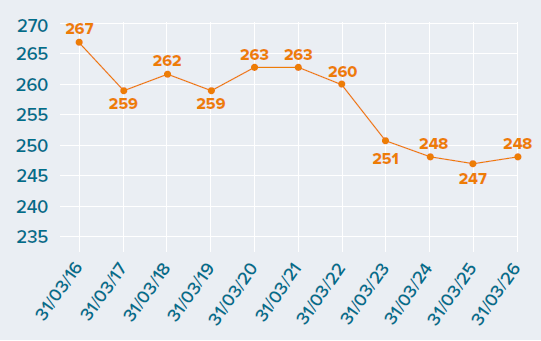
Graph 1: Total number of adult care home services in Wales - with nursing, 2016 to 2026
Graph 2: Total number of adult care home places in Wales - with nursing, 2016 to 2026
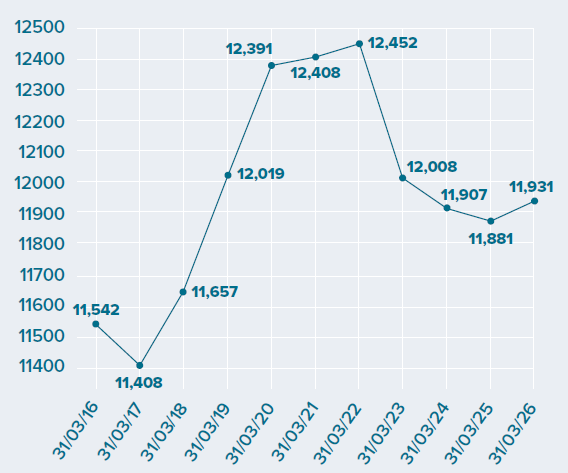
These graphs show the number of adult care home services providing nursing care and their total places in Wales over the ten years from 31 March 2016 to 31 March 2026. Services decreased from 267 to 248 over the decade. Despite this reduction in the number of services, the number of places increased from 11,542 to 11,931, a net gain of 389 places.
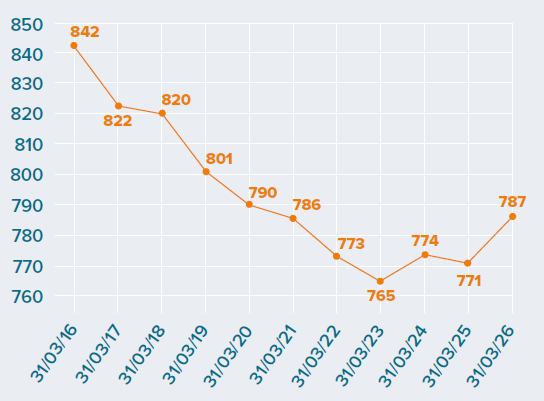
Graph 3: Total number of adult care home services in Wales - without nursing, 2016 to 2026
Graph 4: Total number of adult care home places in Wales - without nursing, 2016 to 2026
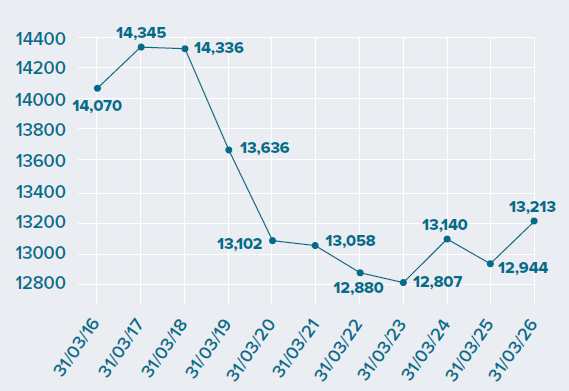
These graphs show the number of adult care home services providing personal care (without nursing) and their total places in Wales over the ten years from 31 March 2016 to 31 March 2026. Services decreased from 842 to 787 over the decade. The number of places also fell from 14,070 to 13,213, a net reduction of 857 places.
Overall, our data suggests a care home sector that is relatively stable in the short term, but continuing to change in composition over the longer term. The number of adult care homes with nursing has fallen over the decade, from 267 to 248, but the number of nursing places has increased by 389. This indicates consolidation into larger nursing homes or changes to registered capacity, rather than a simple reduction in provision.
By contrast, care homes without nursing have reduced both in number and capacity, falling from 842 to 787 services and from 14,070 to 13,213 places. This points to a gradual reduction in personal care home provision, consistent with the wider policy direction of supporting more people to live at home and the growth in domiciliary support services.
However, high occupancy rates suggest continuing demand and limited spare capacity. The recent year on- year position is more positive, with one additional nursing home and 16 more care homes without nursing compared with March 2025, suggesting some short-term stabilisation after a longer period of contraction.
Domiciliary support services
Domiciliary support services provide care to a significant number of people across Wales. According to our most recent annual returns, 34,491 people were in receipt of domiciliary support services on 31 March 2026, with almost 100,000 people receiving support during the year.
The number of services has continued to increase, this year by 35 (4.7%) to 785 operating as of 31 March 2026. We registered 78 services, compared to 87 last year, and handled the cancellation of 43 services (compared to 32). Many of the cancellations were because the service had not operated in the area since registering. Other services stopped operating because they were no longer financially viable or could not secure packages of care to enable them to operate. Seven re-registered with a new provider.
This may be an indicator of the continuing effect of the saturation in the domiciliary care market in some areas, as we described in our 2024-2025 report.
We continue to be concerned about the poor quality of some applications from providers wanting to operate a domiciliary support service in Wales. This year 40 applications to register a domiciliary support service were withdrawn by the prospective provider. We attribute this to the introduction of a triage stage at the start of the registration process which highlights where there are issues with the quality of the application and clarifies the expectations and statutory duties placed on responsible individuals and service providers to operate in Wales.
Ten-year trend in domiciliary support services
The graph below shows the increase in domiciliary support services each year over the last decade.
Graph 5: Total number of domiciliary support services in Wales, 2016 to 2026
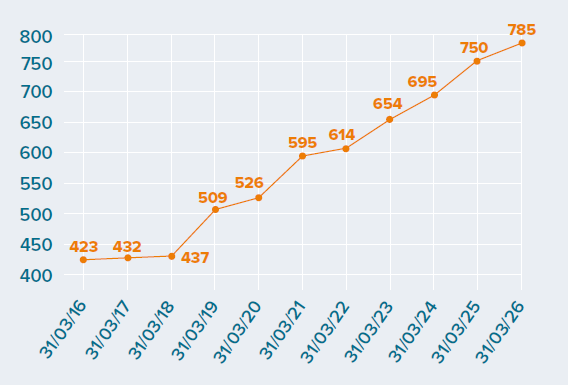
This graph shows the year-on-year growth in the number of domiciliary support services registered in Wales over the ten years from 31 March 2016 to 31 March 2026. The number of services grew from 423 to 785, an increase of 85% over the decade. This growth reflects the policy aim of supporting more people to live at home with tailored care.
Assurance and improvement
Responding to concerns
Concerns raised with us provide important insight into where there may be risks to people’s safety or wellbeing. It is positive that people feel able to share their worries with us. We review every concern and use this information to help us decide when to inspect and what areas to focus on during our inspections. Our first step is to assess the risks the concern presents and consider what we already know about the service. We always prioritise and respond quickly where people may be at risk of or have experienced harm.
This year we received 1,690 concerns including 1,143 about care homes and 545 about domiciliary support services. This is a 13.7% increase from last year. This includes 478 concerns raised by staff working in care homes and domiciliary support services (an increase from 367 last year). People are mostly worried about issues to do with the leadership and management of a service (1,109 concerns) which mirrors what we find in our inspections.
The actions we consider are outlined below and the figures indicate our decisions during 2025/26 (some concerns result in more than one action):
- Keeping a record of the issues raised to inform the planning of our next inspection (651)
- Asking the service to look into the issues shared and let us know the outcome of this to inform the planning of our next inspection (583)
- Making an urgent referral to the local authority safeguarding team or to the police (168)
- Carrying out an urgent inspection (149)
- Sharing information with other authorities and coordinating actions with them as required (128)
- Signposting people to another agency who are better placed to address the issues raised (111)
- Suggesting, if they have not done so already, to make a complaint directly to the service (30)
Reviewing notifications
Regulations specify what providers must notify us about and these notifications provide up to date information about what is happening at a service. This includes notifications about changes to the service, serious accidents or injuries, applications to deprive someone of their liberty, death of a person living in a care home and allegations of abuse.
We receive a high volume of notifications (27,324 this year) some of which may require action by us whilst others are predominantly for information only. We review notifications against what we already know about a service and are alert to any trends that may require a follow-up or further information from the provider.
This year we received 3,921 notifications about an allegation of abuse, each of which we carefully reviewed. These were often about events that are not specified in regulations and did not meet local authorities safeguarding thresholds, for example a fall or missed medication. Consequently, 97% required no further action by us. To address this issue of unnecessary notifications, we started work to clarify definitions which will be introduced in 2026.
Inspection activity and findings
Table 3: Number of inspections performed 2025 to 2026
| Service type | No. of inspections performed |
|---|---|
| Adult & children’s care home service | 12 |
| Adult care home service | 615 |
| Adult placement service | 1 |
| Domiciliary support service | 324 |
| Total | 952 |
This table shows the number of inspections we performed by service type. We inspected 12 adult and children’s care home services, 615 adult care homes, 1 adult placement service and 324 domiciliary support services.
Table 4: Overview of services with published inspection ratings by service type 2025 to 2026
| Service type | Excellent | Good | Requires improvement | Requires significant improvement |
|---|---|---|---|---|
| Adult Care Home Service | 477 | 1,445 | 136 | 86 |
| Domiciliary Support Service | 317 | 478 | 53 | 25 |
| Total | 794 | 1,923 | 189 | 111 |
Footnote: Includes total number of ratings where a service has been inspected one or more times during the reporting period.
This table shows the total number of ratings awarded. Adult care homes had 477 excellent, 1,445 good, 136 requires improvement and 86 requires significant improvement. Domiciliary support services received 317 excellent, 478 good, 53 requires improvement and 25 requires significant improvement.
We award four ratings to care homes and three to domiciliary support services, and this year we awarded 3,017 ratings, 90.1% of which were either ‘good’ or ‘excellent’.
“Excellence is not a rating. It’s experienced daily through meaningful interactions, consistent, personalised care, and the empowerment of residents to live full, enriched lives.”
CIW report: Ratings for care homes and domiciliary support services - Seven months on
Of the services we inspected this year, ratings of ‘excellent’ or ‘good’ across all inspection themes were awarded to 681 services (71.5%) with only 18 (1.9%) receiving a rating of ‘requires improvement’ or ‘requires significant improvement’ across all themes.
All care homes and domiciliary support services should receive a rating by autumn 2026.
Here are just a few examples of the positive practice we have seen this year.
- A supported living service demonstrates how people, their relatives and staff celebrate achievements during weekly house and staff meetings. These achievements are prominently displayed on “Achievement” and “You’re the Best”
notice boards in the office and in the supported living settings for everyone to view. This is a real motivator for people and staff. - A care home providing complementary therapies such as reiki, Indian head massage, and drumming in a calm environment to relax people. There is a remembrance wall of photos for people who have passed away to remember them and celebrate their lives. Fresh flowers grown in the gardens are arranged around the home in water bowls and vases. People living at the care home are involved in the staff selection process.
- A shared lives service which supports people to experience active lives within family settings where they are treated with kindness, compassion and respect. The focus of the service is to enable people to experience fulfilled lives, building their confidence and independence whilst living with a family in comfortable, homely and familiar
surroundings.
There are more case studies on our ‘Adult and children’s services practice worth sharing’ webpage, and in our inspection reports.
Areas for improvement
Our findings from inspection activity, including responding to concerns, show persistent risks around leadership and management, staffing, governance and medication. This suggests that while most services are providing good outcomes, the sector remains vulnerable to operational pressures, particularly where weak oversight, workforce shortages or medication systems affect the safety and consistency of care.
Where we identified improvements were needed, most services made the necessary changes to improve outcomes for people. We inspected 40 services more than once to check improvements had been made.
For example, a care home was issued with PANs following an inspection in 2021. We continued to closely monitor the service which had undertaken significant improvement activity, leading to improved outcomes for people using the service. In our most recent inspection in 2026, it received four ‘excellent’ ratings. The provider was featured in our report on ratings and will be sharing their improvement journey at our first Quality Conference in May 2026.
Leadership and management remained the area we most often identified as needing improvement. We awarded 113 services ratings of requires improvement or significant improvement for this theme, identifying 173 AFI and issuing 69 PANs. Failings here can affect all aspects of care and support, undermining people’s well-being.
The main issues included:
- Weak governance including lack of oversight by the responsible individual, unclear accountability, inadequate quality assurance, insufficient follow-through on service concerns and services not being delivered in line with statement of purpose
- Lack of support and development for staff including issues around supervision, appraisal, training and competency gaps along with incomplete recruitment and vetting weakening assurance that staff are fit to work
- Services lacking sufficient suitably skilled and deployed staff to provide safe, consistent care
- Records being incomplete, inaccurate or out of date, including quality of care reviews, making oversight and safe decision-making harder
We were also concerned to see an emerging issue in relation to medication. We issued 12 PANs and identified a further 15 AFI. Issues included:
- Weak medication oversight and auditing
- Unsafe storage and stock control
- Administration and recording errors
- Out-of-date or unclear medication procedures
We will be monitoring this closely next year.
Only four services (care homes with nursing) received a poor rating in relation to the well-being theme.
The number of services where we take statutory action remains low. This reflects the impact of inspection and enforcement in driving improvements and securing the future of services for the people who depend on them for care and support. Only nine domiciliary support services and 17 care homes were considered at our enforcement panel because of lack of improvement as the next step on our enforcement pathway. This resulted in us issuing nine enforcement notices to six adult services, including improvement notices to cancel a service or Responsible Individual unless improvements were made. These predominantly related to significant failings in leadership and management. Four of these resulted in the cancellation of the service. We enforced variations to impose conditions to mitigate risks to people in seven services.
7.2 Local authority social care for adults
Assurance and improvement
This year we carried out inspection activity in adult services in eight local authorities, three of these jointly with Healthcare Inspectorate Wales (HIW). You can read our local authority inspection and review reports on the CIW website.
CIW inspections:
- Monmouthshire County Council
- Denbighshire County Council
- Blaenau Gwent County Borough Council (improvement check)
- Pembrokeshire County Council (improvement check)
- Ceredigion County Council (improvement check)
Joint inspections with HIW:
We worked with HIW to review the care and support provided to people with learning disabilities or mental health needs, in partnership with the relevant local health board:
- Swansea Council (community mental health team)
- Carmarthenshire County Council (community learning disability teams)
- Torfaen County Borough Council (community learning disability teams)
Positive practice
Across our inspections this year, we found many local authorities making real progress in putting people at the centre of assessment and care, alongside areas where improvement is still needed.
We found strong evidence of local authorities prioritising people’s voice, choice and control, with person-centred and strengths-based practice embedded in how people are assessed and care is planned. We saw this in practice across several local authorities:
- In Monmouthshire, assessments included detailed biographical information to capture people’s strengths and reflect their identity.
- In Pembrokeshire, practitioners routinely use ‘pen pictures’ within assessments and reviews to build a clear understanding of people’s lives and what matters, supporting a more person-centred approach.
- In Newport, a listening-led approach from first contact ensured people’s voice and choice shaped support from the outset.
- In Blaenau Gwent and Torfaen, accessible communication tools helped people take part in decisions about their care.
We continued to find clear evidence that prevention, early intervention and reablement services are making a difference by helping people access support earlier and maintain their independence. For example, Denbighshire’s ‘Talking Points’ approach provides prompt information, advice and assistance to people without requiring a formal referral.
Despite ongoing pressures, we found evidence of effective partnership working between health, social care and other local services to improve access and reduce delays for people. Examples included:
- Health and social care professionals working together in Torfaen through a co-located, multiagency approach which enabled quicker information sharing and stronger coordination of people’s care, enabling people to access services promptly and in line with their needs.
- The ‘Penmorfa Centre for Independent Living’ in Ceredigion is bringing services together to help people live independently.
- Pembrokeshire’s joint forums, where professionals and partners work together to find solutions for people.
- In Carmarthenshire, joint work between the local authority and local health board expanded supported living options and improved coordination of aftercare for people, helping to promote independence and continuity of support.
In the four local authorities where we carried out improvement checks, we found the improvements we had highlighted had been made.
Areas for improvement
Our inspections this year identified persistent challenges with the timeliness of assessments, reviews and first contact in several local authorities.
We received 146 concerns about local authority adult services. Concerns were shared about:
- Care quality and reliability, including assessment timeliness and communication
- safeguarding and human rights, including safety issues
- accommodation suitability or stability
- how local authorities handled complaints and concerns.
We found access to advocacy was inconsistent. In several local authorities, advocacy was not always clearly offered, explained or recorded, meaning some people may not have received the support they needed to fully take part in decisions about their care. We saw inconsistency in how some local authorities identify and respond to carers’ needs. Local authorities needed to improve how they offer and record carers’ assessments, and to make sure carers’ roles and needs are properly reflected in assessment and support planning.
We found local authorities could do more to keep people and organisations informed when safeguarding concerns are raised. People should receive clear, timely updates about concerns they have reported, and learning from safeguarding cases should be shared across services.
Backlogs in the authorisation of Deprivation of Liberty Safeguards (DoLS) continue to create legal and human rights risks. People waiting for assessments may be deprived of their liberty without timely access to the statutory safeguards designed to protect them. We report on this in detail in our Deprivation of Liberty Safeguards annual monitoring report 2024-2025.
Staff capacity and recruitment pressures were regular themes in our inspections. Limited availability of care workers in domiciliary support services created delays in the provision of care and support for some people. In mental health services, shortages of specialist staff, including Approved Mental Health Professionals (AMHPs) and section 12 doctors (doctors approved to make recommendations under mental health law), also delayed access to support for some. These pressures had a greater impact on people in rural areas, where longer travel times and a smaller workforce make both recruitment and service delivery more challenging.
7.3 Social care for children and young people
Profile of services regulated by us
Table 5: Regulated children’s services in Wales as at 31 March 2026
| Service type | No. of services | No. of places |
|---|---|---|
| Children’s care home service | 397 | 1,349 |
| Fostering service | 21 | - |
| LA fostering service | 22 | - |
| LA adoption agency | 5 | - |
| Adoption service | 6 | - |
| Advocacy service | 2 | - |
| Secure accommodation service | 1 | 14 |
| Residential family centre | 5 | 87 |
| Special school residential service | 4 | 45 |
| Boarding school | 10 | 1,272 |
| Further education college | 3 | - |
Footnote: A dash indicates we do not hold this information.
This table shows the number of regulated children's services and available places in Wales at 31 March 2026. There were 397 children's care home services (1,349 places), 21 fostering services, 22 local authority fostering services, 5 local authority adoption agencies, 6 adoption services, 2 advocacy services, 1 secure accommodation service (14 places), 5 residential family centres (87 places), 4 special school residential services (45 places), 10 boarding schools (1,272 places), and 3 further education colleges.
Care homes for children
This year we registered 55 new care homes for children in 20 of the 22 counties in Wales (14.6% increase since March 2025), leading to an additional 125 places. Local authorities now operate 81 care homes for children, a 24.6% increase on the previous year (65).
Fewer care homes cancelled their registration this year, seven compared to 15 last year. Common reasons for cancelling included a child in a single occupancy home turning 18 and moving on or landlords wanting to sell their properties.
Data from the annual returns dashboard shows 1,057 children were living in a care home on 31 March 2026, with an average occupancy rate of 81.9% during 2025-2026.
There remains a lack of services able to meet the needs of children with complex needs.
The transition to a not-for-profit model
This year we prepared for amendments to the Regulation and Inspection of Social Care (Wales) Act 2016, introduced by the Health and Social Care (Wales) Act 2025. The amendments restrict the extraction of profit from the care of looked after children, with a phased implementation beginning on 1 April 2026. After 31 March 2026 only not-for-profit
providers of care homes for children, fostering services and secure accommodation can apply for registration to operate in Wales.
Our registration team published a dedicated Removing profit from children’s care webpage to help providers of children’s services understand what the changes meant for them.
We received 42 applications to register care homes for children in the last quarter of 2025-2026, significantly more than in the previous nine months combined (32).
The Welsh Government publishes six-monthly reports on progress towards the not-for-profit model for children’s care homes. You can read the transition reports on removing profit from children’s care on the Welsh Government website.
As of 31 March 2026, 77.5% (308) of the 397 care homes for children are operated by for profit providers, providing 1,069 places, with 280 places in 89 not-for-profit care homes. Of the current not-for-profit care homes for children, 91% (81) are operated by local authorities.
Over the last decade, the number of care homes for children has more than doubled (176% increase) and the number of places has increased by 112%.
Graph 6: Children’s care home services and places in Wales, 2016 to 2026
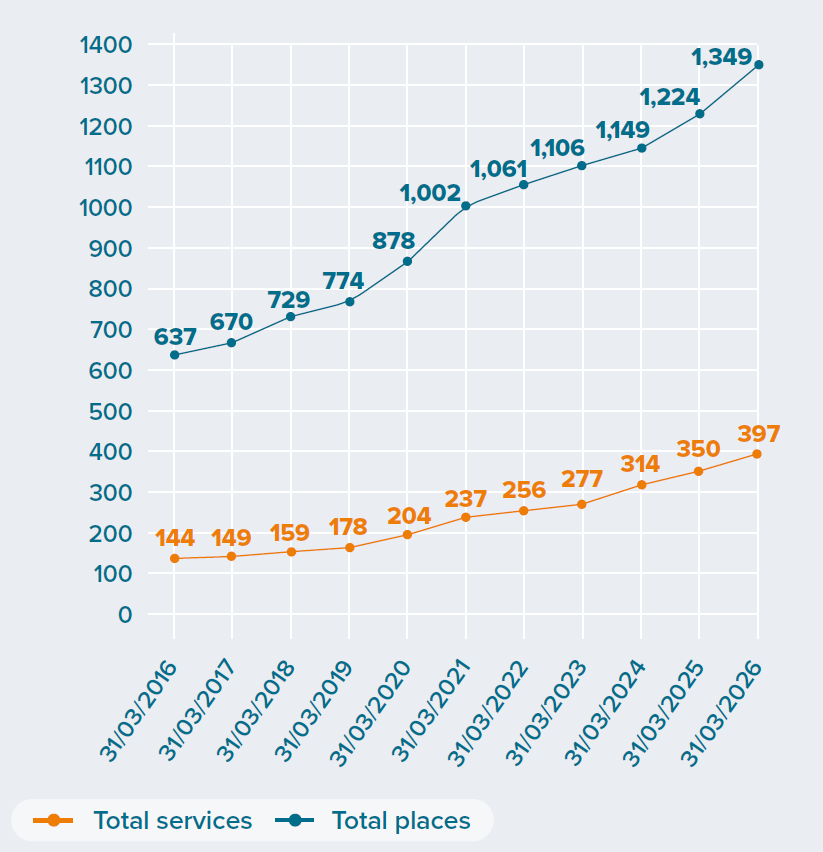
This graph shows the growth in children's care home services and available places in Wales over the ten years from 31 March 2016 to 31 March 2026. Services increased from 144 to 397. The number of places grew from 637 to 1,349.
Assurance and improvement
Responding to concerns
Concerns raised with us provide important insight into where there may be risks to children’s safety or well-being. We review every concern shared with us and they help us decide when to inspect and what areas to focus on. Our first step is always to assess the risks the concern presents and consider what else we know about the service. We always prioritise and respond quickly where people may be at risk of or have experienced harm.
This year we received 201 concerns about regulated children’s services, 87% of which were about care homes. This represents a 95% increase compared with last year, though we could not identify any trends or specific reasons for this, other than the increase in the number of services as described above. We are encouraged people feel able to share concerns with us.
Many concerns (148) related to leadership and management and the quality of care and support (92). We received 33 concerns raised by staff working in a service, almost the same number as last year, and 30 concerns raised by people who live in the same street as a care home. People are mostly worried about issues to do with the leadership and management of a service (74% of concerns compared to 64% last year). We assessed only 13 concerns required us to urgently inspect and for 49% of concerns we asked the service provider to investigate and take action as required, informing us of the outcome.
The actions we consider are outlined below and the figures indicate our decisions during 2025 to 2026 (some concerns result in more than one action):
- Asking the service to investigate the issues shared and let us know the outcome of this to inform the planning of our next inspection (99)
- Keeping a record of the issues raised to inform the planning of our next inspection (75)
- Making an urgent referral to the local authority safeguarding team or to the police (20)
- Carrying out an urgent inspection (13)
- Signposting people to another agency better placed to address the issue raised (7)
- Sharing the information with other authorities if there are serious issues and coordinating actions with them (6)
- Suggesting, if people have not done so already, to make a complaint directly to the service (3)
Reviewing notifications
Regulations specify what events providers must notify us about and they provide up to date information about what is happening at a service. Notifications include informing us about changes at the service, when a child is missing, allegations of abuse and high court orders relating to deprivation of liberty. We review notifications in the context of what we already know about the service and are alert to any trends that may require us to follow up or request further information from the provider.
We received 8,669 notifications this year, some of which may require action by us, others are predominantly for information only.
We received 600 notifications of an allegation of abuse and 931 informing us about child protection enquiries, each of which we carefully reviewed. These were often about incidents that are not specified in regulations and did not meet local authority safeguarding thresholds. After reviewing these and speaking with the provider for more information, we found that the majority required no further action from us, such as cases involving peer-on-peer incidents or the disclosure of historical abuse unrelated to the care service.
This is also the case with notifications of children going missing where we received 3,758 notifications (a 29.5% increase on last year). The notifications relate to over 500 children, most of whom were reported missing on a single occasion although 15 children or young people were each reported missing on over 40 occasions accounting for 782 notifications. Often, their whereabouts were known and they were safe, for example a curfew time had been breached
whilst meeting with friends. Care experienced children have said they resent being labelled as ‘missing’ in these situations. We have therefore reviewed our definition of what must be reported to us, to align with the police definition of a missing person:
“Anyone whose whereabouts cannot be established will be considered as missing until located and their well-being or otherwise confirmed.”
This change will be implemented in 2026.
Inspection activity and findings
Table 6: Inspections of registered children’s services by service type, 2025 to 2026
| Service type | No. of inspections 2025 - 2026 |
|---|---|
| Children’s care home service | 205 |
| LA fostering service | 6 |
| Fostering service | 3 |
| Boarding school | 6 |
| Further education college | 2 |
| Residential family centre | 2 |
| Secure accommodation service | 1 |
| Special school residential service | 1 |
| Grand Total | 226 |
This table shows the breakdown of inspections carried out across registered children's services during 2025 to 2026. CIW completed 226 inspections in total, comprising 205 children's care home services, six local authority fostering services, six boarding schools, three fostering services, two further education colleges, two residential family centres, one secure accommodation service, and one special school residential service.
We only award ratings for care homes and have found most are delivering good outcomes for children and young people.
Table 7: Overview of ratings awarded to care home services for children in, 2025 to 2026
| Excellent | Good | Requires improvement | Requires significant improvement | |
|---|---|---|---|---|
| Care home services for children | 263 | 389 | 58 | 18 |
Footnote: Includes total number of ratings where a service has been inspected one or more times during the reporting period.
The table shows ratings awarded to care homes for children in 2025-26. 263 excellent, 389 good, 58 requires improvement, 18 requires significant improvement.
Of the 205 homes we inspected this year, 90% of the ratings we awarded were ‘good’ or ‘excellent’, with 148 (72%) care homes receiving good or excellent ratings across all four inspection themes. Only five care homes (2.4%) were found to require improvement or significant improvement across all four themes.
Case study 1: Short break service for disabled children with four excellent ratings
Our inspection report noted:
“Children’s well-being is promoted to an excellent standard. They are supported to make choices about meals, activities, and routines, which encourages independence and confidence. Families value the strong relationships with care staff and the regular updates provided during children’s stays. Children enjoy a wide range of activities, including opportunities in the community, which enhance their happiness and quality of life.
Care and support are delivered to a very high standard. Personal plans are clear, regularly updated, and provide care staff with practical guidance to meet children’s needs. Feedback from families is overwhelmingly positive, with many describing the care as excellent and reassuring.
Recent refurbishment has created a welcoming and comfortable space for children. The environment supports children’s well-being and enables care staff to deliver high-quality care”.
Case study 2: Care home for disabled children described as ‘life-changing’
One family told us the care and support provided by a care home for disabled children was “life-changing at a time of crisis”. Through consistent, nurturing care and strong relationships, the placement gave their child stability, security and the confidence to thrive. The family saw clear improvements in emotional wellbeing and behaviour, while the respite and support provided helped them recover and strengthen family relationships. Their experience shows the powerful difference compassionate, well-managed residential care can make for both children and families. At the last inspection the home was awarded three good ratings and a rating of excellent for leadership and management.
Case study 3: From care home to published author
A child living in a care home started writing stories and was supported by staff to develop these stories into a book with matching illustrations. The service provider published the book and during the 2025 Easter holidays, held a book signing where their friends, family, staff and children from the provider’s other services could celebrate their achievement. This service was awarded four excellent ratings.
To note: we do not currently publish inspection reports for children’s care home services on our website.
Local authority fostering services
Last year we reported the emerging findings of our inspection of local authority fostering services. These inspections continued this year and we found strong evidence of effective support for foster carers and children across most local authorities, with therapeutic and trauma-informed approaches, positive child experiences, and good access to advocacy, education support, and transition planning. Innovative practices and generally effective oversight further strengthened provision.
Boarding schools
This year we inspected six boarding schools, and our findings were mainly positive. We identified some common themes including a lack of formal supervision processes, although some settings demonstrated stronger appraisal systems. Safeguarding practices were generally robust, but we found variation in the quality of welfare plans, with a limited focus on outcomes for children.
Deprivation of Liberty orders
Deprivation of Liberty (DoL) orders are issued by the High Court to keep children safe in the absence of other options (such as a secure children’s home) and are usually as a result of short-term crisis planning. We are aware of the reported rise in these orders in England and Wales. The Nuffield Family Justice Observatory reported 1,440 deprivation of liberty applications in 2025 – an increase of 12.5% since 2024.
This rise has been attributed to an increase in adolescent children entering care with complex issues, limited access to mental health and early intervention services, and a shortage of therapeutic children’s home and foster carer placements with the skills and experience needed to provide support and meet the needs of these children.
There are alternative models in Wales, such as the multi-agency MyST (My Support Team) model available in some areas, an intensive mental health service for children in care or on the edge of care which works with their carers to provide holistic, long-term support before issues escalate to the point where a DoL might be needed.
As the regulator, CIW is only notified when a child in a children’s home has a DoL order in place. In 2025, we received 73 notifications from 42 homes about a child living in a care home with a DoL order (compared with 50 notifications last year). Many of these applications relate to the renewal of an order rather than representing 73 different children. For example, one care home submitted eight notifications for one young person over a period of seven months.
Although the number of children living in care homes subject to DoL orders remains small, we are concerned about the impact on how care and support is provided, both for the individual child and for other children living alongside them. Any restrictions should be proportionate, necessary and responsive to the child’s complex needs. This year, on two occasions where we found unnecessarily restrictive environments, we have taken action to secure improvements.
Areas for improvement in social care for children and young people
This year we issued 19 PANs to 18 services in relation to standards of care and support or leadership and management. We inspected four care homes more than once to check improvements had been made. It is always positive to see improvements made which enhance the well-being of children and promote positive outcomes. For example, we inspected a care home in March 2025 and issued PANs. When we reinspected in September, we awarded four good ratings. We found managers had effectively navigated the service through a challenging period, improving the well-being of both children and care staff. Reliance on agency care staff had reduced, ensuring children were cared for by permanent care staff with whom they could build trusting relationships.
Six children’s services were referred to our enforcement panel resulting in statutory notices being issued to four services. Three made the necessary improvements; however, one service had its registration cancelled.
Our inspections of local authority fostering services identified recurring challenges across Wales. These included sustained difficulties with recruitment and retention of foster carers, weaknesses in placement matching, and inconsistent arrangements for enabling children to participate meaningfully in planning and decision-making. We also found variation in safeguarding practice, gaps in training and development, inconsistencies in education tracking, and limited clarity in relation to kinship care. Differences in service structures further highlighted the need for greater consistency in practice, oversight and outcomes for children.
7.4 Local authority children’s services
Assurance and improvement
This year we carried out inspections in 10 local authorities. This included inspections of three regional adoption collaboratives (RAC) and two improvement checks (IC) to follow up on progress made since our last inspection. You can view local authority inspection and review reports on the CIW website.
We responded to 93 concerns about local authority children services. These mostly related to service quality and decision-making (such as delays in assessment or communication), concerns about safety and court-related matters, whether the right action has been taken, and support provision including placements.
Positive practice
Across our inspections this year, we found many examples of local authorities working hard to promote children’s rights and improve outcomes for children and families, alongside areas where further improvement is still needed.
Children’s rights and participation
Our inspection and engagement work this year found a strong focus on children’s rights across children’s services. We saw many services making sure children are listened to, with their views reflected in plans and decisions underpinned by trauma-informed and strengths-based approaches. For example:
- Flintshire showed effective practice in ensuring children’s voices were listened to in child protection and care planning, including ‘conference buddies’ and child-friendly approaches for children to share their views.
- Isle of Anglesey and Caerphilly demonstrated child-friendly practice that helped children understand what is happening and take part in decisions. Isle of Anglesey County Council wrote directly to children and used tools to capture their views, while Caerphilly County Borough Council used trauma-informed and strengths-based approaches.
- In Neath Port Talbot, children and young people helped improve how services communicate using plain language by co-producing language guidance.
- In Gwynedd and the North Wales Regional Adoption Collaborative, children actively contribute to staff interviews by attending panels or writing questions.
Early help and prevention
We found examples across several local authorities of effective early help, prevention and family support services making a positive difference for children and their families. Common strengths included ’edge of care’ support that helped children remain safely with their families, family support teams working with families earlier, and preventative approaches such as family group conferences and parenting support. These approaches help strengthen family networks,
reduce escalation to statutory services and reflect positive progress towards meeting the aims of the Social Services and Well-being (Wales) Act 2014.
Safeguarding partnerships
We found safeguarding to be most effective where education, health services and police are consistently involved to support prompt, joined-up decisions. For example, in Bridgend, a multi-agency safeguarding hub brings partners together to share information and agree actions, supported by a professional advice line. Flintshire’s redesigned ‘front door’ included a safeguarding hub, with clearer threshold guidance and practical decision-making tools, helping
professionals reach consistent decisions and ensure families received the right help earlier. Blaenau Gwent showed strong joint working through multi-agency supervision and outcome meetings, supporting shared oversight of risks across partners.
The Gwent Single Point of Access model demonstrates what integrated pathways can achieve. A single shared ‘front door’ gives families and professionals a clearer route to advice, triage and the right support, with smoother handovers between services.
Adoption and fostering
We also saw positive practice in local authority adoption and fostering services, particularly helping children understand their story and stay connected to people who matter to them. Western Bay RAC showed strong life-journey work co-produced with carers and birth families, with quality checks alongside child-centred contact support and timely intermediary services. North Wales RAC strengthened life-journey work through dedicated roles, guidance and therapeutic approaches such as later-life letters and stories. It also supported connection by helping adopters and birth families meet, where appropriate. In Neath Port Talbot, Parent Advocacy Network cafés and youth-led groups help families have their voices heard and shape the local support they received.
Overall, our inspections across local authority children’s services this year showed continued progress, with strengthening practice and systems in many areas contributing to better outcomes for children and families.
Areas for improvement in local authority children’s services
We identified shared areas for improvement, including differences in how agencies assess risk and make decisions about when additional support or intervention is needed. While core processes are in place, there are still too many occasions where key steps are not always completed as quickly as they should be, and where decisions and outcomes are not always clearly recorded or shared. We also found some variation in the quality of assessment,
particularly in how clearly risks and needs were analysed and explained. In addition, advocacy was not always offered or recorded consistently. This can limit how well children and families are supported to take part in decisions about their care.
System pressures also affect the ability to secure the right placements, particularly for children with more complex needs. Challenges around placement sufficiency featured regularly in our work, including difficulty finding suitable local placements. Encouragingly, some areas are seeing greater stability, but workforce capacity and access to specialist roles remain under pressure which can affect support continuity and timeliness. At the same time, services are responding to increasingly complex and overlapping needs within families. Passionate and dedicated staff are working hard to respond to these pressures, but the complexity of some children’s needs continues to place demands on the system.
Children’s experiences are not yet consistent across Wales including differences in how quickly support is provided, how well services keep children and families informed, and how effectively information is shared between agencies. This means some children experience delays or gaps in support. These challenges are more noticeable for care-experienced children and those who are neurodiverse, where delays in assessment or changes in placements or education disrupt support and make it harder to maintain stable relationships and consistent plans.
Children’s mental health: joint thematic review
Our joint thematic review with HIW and Estyn of children’s mental health in 2024 identified an urgent need for a more responsive, equitable, and integrated mental health support system for children and young people. We also highlighted a clear, strong commitment to partnership working, with many good examples of services working together to support children. Since publication, we have worked with partners to review regional improvement plans, engage safeguarding boards, and monitor progress in implementing the report’s recommendations. Whilst further improvements are needed, we have seen encouraging signs of strengthened partnership arrangements and improving experiences of children
in some areas, including more coordinated responses and clearer pathways of support.
Services operating without registration
This year we determined 76 care homes for children as operating without registration (OWR). A similar number to last year (74) but a considerable reduction from the 117 recorded in 2023-24. We saw reductions in the length of time some homes operated without registration. Where placements last for a longer period, this reflects the complex needs of the children living there.
In most cases, local authorities were providing these services for children in their care and have told us they only use unregistered care homes as a last resort when there are no suitable registered placements available. We have seen a positive trend in local authorities placing young people in premises they intend to register. While these services are still operating without registration, placing children in premises intended for future registration supports stability and reduces the need for children to move multiple times.
CIW’s approach to services operating without registration
CIW’s position is clear: operating a service without registration is illegal and is not an acceptable substitute for appropriate registered care. The only legal action available to us against an unregistered provider is criminal prosecution, which requires the consent of the Counsel General. We recognise local authorities have dual legal responsibilities: to accommodate a child and to do so in a registered setting that meets the child’s needs. We have developed an escalation process which takes a proportionate, case-by-case approach to all enforcement decisions. As part of this approach, we seek assurance from local authorities about how children in such arrangements are safeguarded and how risks are identified, monitored and managed. In addition, we seek information about a local authority’s plans to either register the service or place the child in an appropriate registered setting.
Our local authority inspection activity has found structured oversight, including senior scrutiny of placement decisions, ongoing review of risk and suitability, and arrangements to monitor children’s safety and well-being while longer-term placements are secured. Care planning continues during these periods, with multi-agency involvement where required, and a focus on promoting stability and progressing children to registered provision at the earliest opportunity.
Overall, there is no clear indication that the situation is improving or deteriorating over time. It highlights the continuing challenge of securing sufficient, suitable and sustainable registered placements for children with complex needs who require access to a range of specialist services. The continued use of unregistered placements underlines the importance of work locally, regionally and nationally, to strengthen access to appropriate registered placements so that children can consistently receive care in services subject to full regulatory oversight and inspection.
Safeguarding children and young people
In 2022, following several tragic child deaths across England and Wales, we carried out a multi-agency Child Protection Rapid Review (CPRR) of child protection arrangements, with a particular focus on decision-making. This year, jointly with Estyn and Healthcare Inspectorate Wales (HIW), we followed up on progress in implementing the recommendations of the review. We found a strong commitment from safeguarding partners to implement the recommendations and to address the barriers to doing so. Regional Safeguarding Boards (RSBs) undertook self-assessments to maintain focus and measure their progress against our recommendations.
The improvement plans submitted by each region demonstrated clear determination to strengthen multi-agency working, enhance child-centred practice, and improve governance and accountability. There has been progress in partnership working, standardisation of thresholds, and child-centred practice supported by multi-agency training initiatives. Governance and assurance mechanisms have been strengthened. Nationally, Wales Safeguarding Procedures are being further developed with updates due to be published in summer 2026.
However, challenges remain in achieving consistency, robust data-sharing, and addressing workforce pressures. Continued national coordination and targeted support will be essential to maintain momentum and deliver the improvements envisaged by the review.
This year, the publication of the Our Bravery Brought Justice report had serious implications for safeguarding in Wales. It demonstrated that, despite the progress made, continued vigilance remains essential. It rightly prompted renewed scrutiny of how effectively systems identify, respond to and escalate concerns where children may be at risk from people in positions of trust.
We responded by strengthening our regulatory and system assurance role. We worked closely with partners, including Estyn, and in November 2025 undertook targeted inspection activity in Gwynedd to examine safeguarding arrangements, leadership oversight and the handling of allegations against those in positions of trust. This work provided both challenge and assurance and reinforced the importance of translating governance and policy commitments into consistently strong practice on the ground. We continue to emphasise the centrality of listening to children, professional curiosity, and clear accountability where concerns are raised.
We have started planning for a national thematic review of the operation of section 5 of the Wales Safeguarding Procedures in early 2027. This will focus on allegations against people in a position of trust working with children. This work, planned prior to the Child Practice Review but given added urgency by its findings, will examine practice, thresholds and oversight across Wales. Alongside this, we will continue to reflect on our own inspection approaches and learning, ensuring our regulatory activity provides the strongest possible assurance for children, families and Ministers.
7.5 Childcare and play services
Profile of registered services
Table 8: Childcare and play services and places in Wales by service type as at 31 March 2026
| Service type | Number of services | Number of places |
|---|---|---|
| Childminder | 1,364 | 11,336 |
| Crèche | 10 | 377 |
| Full day care | 1,149 | 46,111 |
| Open access play provision | 33 | 2,377 |
| Out of school care | 287 | 12,325 |
| Sessional day care | 296 | 6,842 |
| Total | 3,139 | 79,368 |
This table shows the number of registered childcare and play services and available places in Wales at 31 March 2026. There were 3,139 services in total providing 79,368 places, comprising 1,364 childminders (11,336 places), 1,149 full day care services (46,111 places), 296 sessional day care services (6,842 places), 287 out of school care services (12,325 places), 33 open access play provision services (2,377 places), and 10 crèches (377 places).
During the year, 102 full day care services registered and 92 cancelled their registration, fewer than last year. Where reasons for cancellation were given, the majority were because they were re-registering under different legal ownership. However, several services closed because they could not recruit and retain suitably qualified staff. Others cited financial reasons, including increases to the minimum wage, national insurance contributions and overheads.
This year 63 childminders registered (the same number as 2024-25). Whilst fewer childminders cancelled their registration than last year (116 compared to 147) the decline in the number of childminders in Wales continued. Common reasons given for childminders cancelling their registration included leaving to pursue careers in other areas, changes in family circumstances and retirement.
We have seen some sessional services transition to provide full daycare by expanding their hours. This has increased the number of places offered, stabilising overall capacity despite there being fewer registered services.
This year, whilst there has been a 3.7% reduction in the number of childminders (315 fewer places), full day care services have increased by 2.5% providing 1,927 more places for children. The pattern may reflect parental preferences and demand, as well as the financial and operational benefits of larger-scale provision.
Ten-year trend in childcare and play
Over the past decade, there has been an interesting trend in the overall number of childcare and play services and places in Wales. We have seen a gradual reduction in the number of services, with 28.5% (1250) fewer than 10 years ago. There was steady growth in the number of childcare and play places between 2016 and 2021, after which the number of places began to fall, with 5,140 fewer places as of March 31 2026 compared to the peak in 2021 when there were 84,508. In our view, this is because many smaller services did not resume or continue to operate following the COVID-19 pandemic.
The number of crèche services fell from 28 to 10 (212 fewer places), open access provision from 56 to 33 (though providing 99 more places), out of school from 444 to 287 (4,036 fewer places) and sessional day care from 765 to 296 (with loss of 10,367 places). We are aware a large number of sessional settings have changed their category to full day care to make themselves sustainable. Some smaller services now operate for less than two hours and so are not required to register with us.
In the same period, the number of full day care services has grown by 70% providing 61% more places. In contrast, childminders fell by 43.6% from 2,419 to 1,364.
Overall, the figures point to a sector that is changing shape rather than simply contracting. The total number of registered childcare and play services has fallen over the last decade, but this has not translated into an equivalent fall in capacity. Instead, provision appears to be consolidating into larger settings, particularly full day care, where both the number of services and the number of places have increased substantially. At the same time, the continuing decline in childminders and sessional day care suggests smaller and more flexible forms of provision are under sustained pressure. This matters because these services often provide local, family-based or part-time options that can be important for parental choice, rural communities and children who may benefit from smaller settings. The recent year-on-year figures reinforce this pattern: full day care expanded, while childminder numbers and places continued to fall. The sector is therefore maintaining overall capacity, but through a different mix of provision, with potential implications for accessibility, flexibility and parental choice.
Graph 7: Total number of childcare and play services in Wales, 2016 to 2026
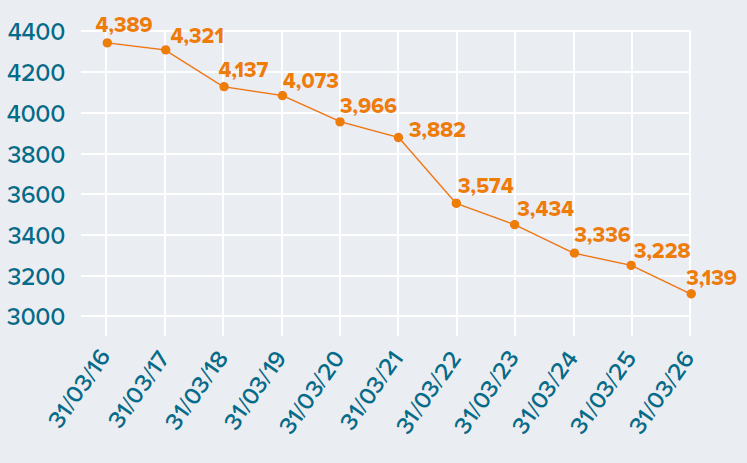
Graph 8: Total number of childcare places in Wales. 2016 to 2026
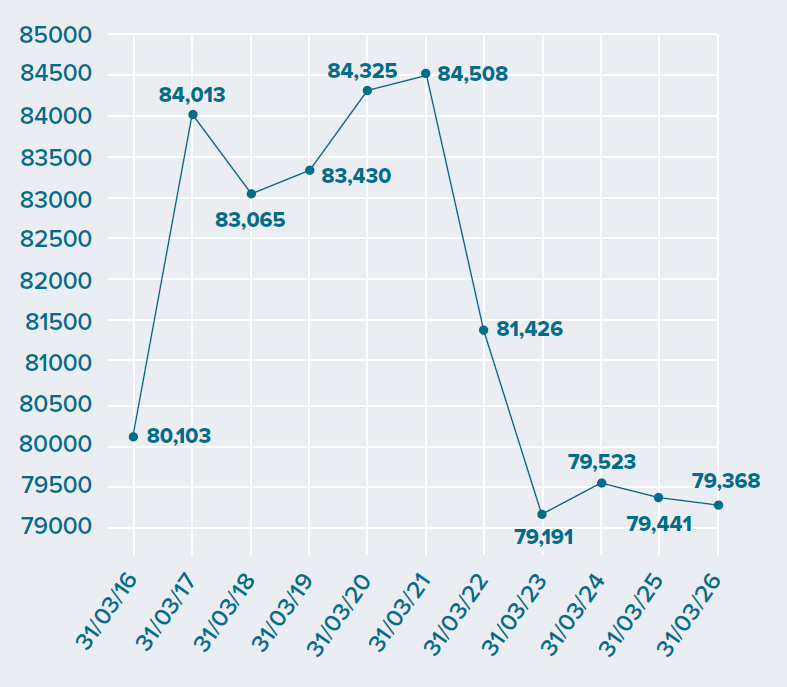
These graphs show a reduction in the overall number of all childcare and play services and places between 2016 and 2026.
Graph 9: Total number of full day care services in Wales, 2016 to 2026
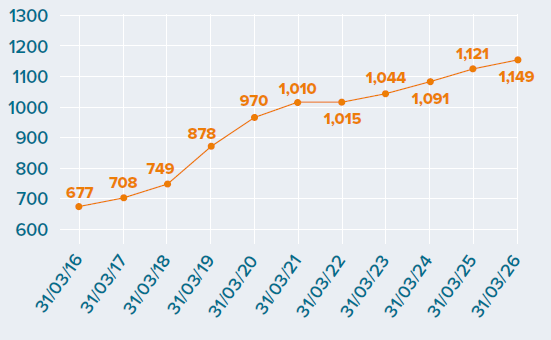
Graph 10: Total number of full day care places in Wales, 2016 to 2026
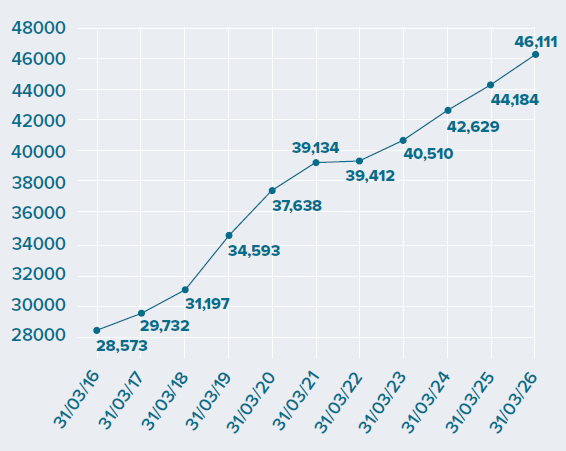
These graphs show the growth in full day care services and available places in Wales over the ten years from 31 March 2016 to 31 March 2026. Services increased from 677 to 1,149, a rise of 70%. The number of places grew from 28,573 to 46,111, an increase of 17,538 places (61%).
Graph 11: Childminder services and places in Wales, 2016 to 2026
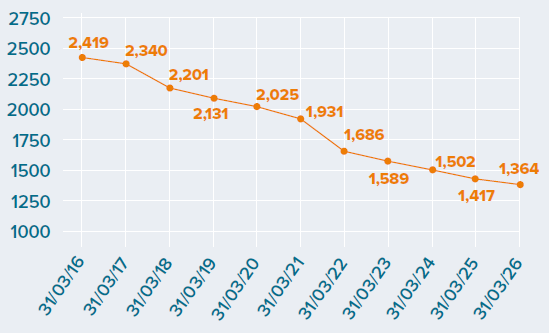
Graph 12: Total number of childminder places in Wales, 2016 to 2026
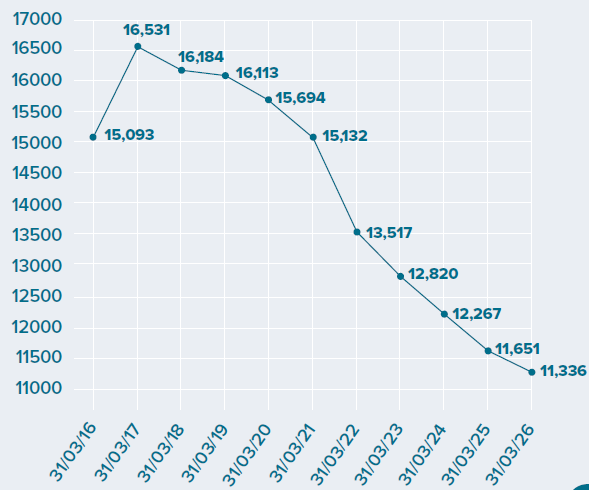
These graphs show the decline in the number of registered childminder services and available places in Wales over the ten years from 31 March 2016 to 31 March 2026. Services fell from 2,419 to 1,364, a decrease of 44%. The number of places fell from 15,093 to 11,336, a loss of 3,757 places.
Assurance and improvement
Responding to concerns
Concerns raised with us provide important insight into where there may be risks to the safety or well-being of children.
We received 411 concerns (compared with 481 last year), 82% of which were in relation to full day care settings. Most concerns were about leadership and management. In 77 instances the concern was raised by a whistle blower. We continue to be encouraged that care practitioners know they can, and do, raise concerns with us.
We review every concern. They help us decide when to inspect and what areas to focus on. We have several actions we can take, and our first step is to assess the risks the concern presents and consider what else we know about the service. We always prioritise and respond quickly where children may be at risk of or have experienced harm.
We assessed 107 concerns to have a potential major impact on children, leading us to carry out an urgent inspection to check children were appropriately safeguarded. Other actions we consider are set out below. Because some concerns resulted in more than one action, the total figures exceed the number of concerns raised.
Other actions we consider are set out below. Because some concerns resulted in more than one action, the total figures exceed the number of concerns raised.
- Making an urgent referral to the local authority safeguarding team or to the police (16)
- Asking the service to investigate the issues shared and let us know the outcome of this to inform the planning of our next inspection (130)
- Keeping a record of the issues raised to inform the planning of our next inspection (148)
- Signposting people to another agency who are better placed to address the issues raised (3)
- Suggesting, if they have not done so already, to make a complaint directly to the service (14)
- Sharing the information with other authorities and coordinating actions with them as required (3)
Reviewing notifications
Regulations specify what events providers must notify us about and they provide up to date information about what is happening at a service. We received 7,880 notifications this year, some of which required action by us, others were for information only. We review notifications against what we already know about the service and are alert to any trends that may require us to follow up or request further information from the provider. Most notifications (80%) related to changes at the service such as staffing or changes to the statement of purpose. Notifications about alleged harm or abuse fell by 6.9% compared with last year, to 285.
Inspection activity and findings
This year we completed 1,013 inspection activities (644 inspection site visits and 369 quality meetings). In all our activities we actively promoted the guidance and resources linked to the Early Childhood Play, Learning and Care (ECPLC) framework.
Table 9: Number of inspections or quality meetings performed in 2025-2026
| Inspections | CC&P Quality Meeting | Total | |
|---|---|---|---|
| Childminder | 234 | 136 | 370 |
| Crèche | 2 | 1 | 3 |
| Full day care | 280 | 162 | 442 |
| Open access play provision | 4 | 3 | 7 |
| Out of school care | 64 | 33 | 97 |
| Sessional day care | 60 | 34 | 94 |
| Grand Total | 644 | 369 | 1,013 |
This table shows the number of inspections and quality meetings carried out across childcare and play services in 2025-2026 by service type. We conducted 644 inspections and 369 quality meetings, resulting in 1,013 inspection activities overall. This included activity with 370 childminders, 442 full day care settings, 97 out of school care settings, 94 sessional day care settings, seven open access play provision settings and three crèches.
This year we started to revise our inspection framework, moving from four inspection themes to three. This brings together previously separate elements around care and well-being and incorporates assessment of the effectiveness of the environment throughout the three themes, rather than in a standalone theme. This development is also being shaped by recommendations from the Independent Review of Childminding and the Ministerial Review of Play.
We plan to engage with providers and sector representatives to gather feedback and make any relevant amendments ahead of implementation next year.
We have been working with Estyn since 2019 to jointly inspect the care and education of children in non-maintained settings which are funded to provide part- time education to three and four year olds. This year we inspected 90 services together. We found most services provide good or excellent care for children.
Along with Estyn, we have continued to work on a review of the joint inspection framework. A joint working group has developed an updated framework that supports a truly joint inspection process that allows us to report our findings more clearly and concisely. The revised framework will ensure key Welsh Government initiatives are included, such as the Anti-racist Wales Action Plan, the principles of ECPLC, and the current guidance around supporting children with additional learning needs.
Our inspections this year found most childcare and play settings continue to provide high-quality care for children.
Table 10: Childcare and play inspection ratings by service type, 2025 to 2026
| No. of ratings | Excellent | Good | Adequate | Poor |
|---|---|---|---|---|
| Childminder | 191 | 600 | 161 | 18 |
| Crèche | 0 | 6 | 2 | 0 |
| Full day care | 194 | 666 | 184 | 28 |
| Open access play provision | 9 | 6 | 1 | 0 |
| Out of school care | 29 | 134 | 52 | 13 |
| Sessional day care | 43 | 141 | 27 | 4 |
| Total | 466 | 1,553 | 427 | 63 |
Footnote: Includes total number of ratings. Some services have been inspected more than once during the reporting period.
This table shows the inspection ratings awarded to childcare and play services during 2025 to 2026, broken down by service type. CIW awarded 2,509 ratings in total: 466 excellent, 1,553 good, 427 adequate, and 63 poor.
Of the services we inspected this year, 405 services (63%) received excellent or good ratings and a further 161 received excellent / good / adequate ratings, meaning 88% of childcare and play services received excellent, good or adequate ratings across all four themes this year. Only 18 services received adequate ratings across all themes, and no service received poor ratings across all four themes.
An ‘adequate’ rating is awarded if the setting is operating in line with the regulations and national minimum standards and is safe and meeting basic requirements. We want all childcare and play services to continuously improve and aspire to be good or excellent to promote well-being and improve outcomes for children.
We have been publishing ratings for childcare and play services since 2019 and over the last six years, 79.8% of services with a published inspection report have been rated as excellent, good or adequate across all four inspection themes; with 55% receiving the higher ratings of excellent or good across all themes. This provides a strong indication of the quality of childcare in Wales.
The inspection and assurance figures suggest that quality across the sector remains broadly positive, but with a clear need to continue supporting improvement. Only a very small number of services received consistently poor ratings. This indicates that the majority of settings are safe and meeting children’s needs, with many providing good or excellent experiences. However, the 272 AFI and 92 PANs show that weaknesses remain, particularly in leadership and management. The fact that most poor ratings and PANs related to leadership, management and staffing indicates that governance, recruitment, suitability checks and oversight are the main pressure points. Although the number of concerns fell compared with last year, most continued to relate to leadership and management, and more than a quarter were assessed as having potential major impact on children, leading to urgent inspections. Taken together, the figures show a sector that is generally delivering positive outcomes for children, but one where financial pressures, recruitment challenges and weakening smaller-scale provision continue to create risks that require close monitoring.
Areas for improvement in childcare and play
In total, we identified 272 Areas for Improvement (AFI) and we issued 92 PANs where we found outcomes for children were poor.
Only 63 services were given a poor rating, 40 of which were in relation to failings in leadership and management and resulted in us issuing 56 PANs to make immediate improvements in this area. The main issues with leadership and management related to staffing including safe recruitment practices (79 AFIs and 21 PANs).
We monitored all settings on our enforcement pathway to track their progress and ensure improvements were sustained. We inspected 46 services more than once to ensure appropriate improvements had been made. Where we did not find sufficient improvement, we referred the service to our enforcement panel. Referrals reduced this year, reflecting the impact of effective early intervention, stronger partnership working with local authorities and umbrella bodies, and quality meetings.
We suspended nine services, primarily due to police and safeguarding investigations taking place. One suspension was lifted; two services subsequently voluntarily cancelled their registration with six ongoing as of 31 March 2026. We cancelled the registration of three services after they failed to engage with CIW over a sustained period.
In our quarterly meetings with sector partners, recruitment and retention difficulties and financial viability are consistent themes. While the immediate post-pandemic pressures have eased, feedback suggests providers remain anxious about cost pressures and funding.
We also found evidence that some providers are not always carrying out timely suitability checks on staff, which may reflect recruitment and retention pressures in a competitive labour market. We monitor these issues through inspection and our broader intelligence-led approach to regulation.
Facilitating appropriate support for children with Additional Learning Needs (ALN) also continues to be challenging for some providers.
Practice worth sharing
When we find examples of particularly effective practice which has a positive impact on children, we ask providers to tell us more about what they are doing and how the children in their care have benefited. We share these examples of practice worth sharing on our website and social media channels to encourage other providers to consider how this
learning can be applied to their own settings.
Themes from our practice worth sharing report
In March we published Lessons from practice worth sharing in childcare and play, which identified four common themes:
- Child-centred and emotionally attuned practice: The strongest settings put children’s emotional well-being first. They helped children feel safe, confident and included, and supported them to understand feelings, build relationships and develop positively.
- Inclusivity and cultural awareness: Good providers made children and families feel welcome by valuing their identities, cultures, languages and backgrounds. They used inclusive, anti-racist and personalised approaches in
everyday practice helping children and families feel welcomed and understood. - Innovative use of the environment: Many providers used outdoor spaces and community links well. Nature-based play helped children learn, explore and build confidence, while community activities helped develop empathy
and social awareness. - Reflective and intentional practice: Providers were not simply doing things because they had always done them – they were observing, reflecting, adapting and improving. They used tools such as the ECPLC Reflective Practice Tool to shape practice and improve children’s experiences.
Case study: Forest school, Conwy
A forest school in Conwy provides child-led outdoor learning where children have freedom to explore creatively while learning about risk and safety. Many children return year after year, always discovering something new. The approach builds resilience and confidence through activities such as physical challenges like tree climbing and creative problem-solving, including experimenting with materials to make mud slides faster. They also have safety talks followed by opportunities to try out new activities.
“Seeing a child arrive nervous and leave covered in mud, smiling and proud of what they’ve achieved, is the best part of forest school.”
Read this forest school’s practice worth sharing case study.
Quality meetings
Quality meetings are held online between an inspector and a provider. They are improvement and outcome focused professional conversations held in between formal inspections. This year we met with 369 services who used these meetings to reflect on their practice. The meetings provided an opportunity for providers to tell us about the improvements made since their last inspection and share any other areas they have identified as needing improvement. We
were able to signpost to useful tools and resources.
The quality meetings were mostly positive and provided us with reassurance about the settings’ arrangements for continuous self-reflection and improvement. Only eight resulted in an unsatisfactory outcome where the provider was unable to reassure us suitable arrangements were in place for improvement or where we identified potential risks to children’s safety or well-being. In these instances, we brought forward a full inspection of the setting.
Here are some examples of feedback from providers:
“So nice to meet an Inspector in a non-inspection situation and have a good discussion as we’ve all got the same aims.”
“The contact with the Inspector is very informative and allowed us to ask any questions regarding the setting. The inspector provided feedback on our quality of care reviews that was informative and encouraging. Receiving this kind of support and reassurance is a huge benefit to the setting. Thank you from the team.”
“This meeting gave us a great opportunity to again discuss our last inspection and share what we have put in place to continue to improve. I think this will also benefit the provider/inspector working relationship and create more relaxed inspections.”
Quality conferences
Quality conferences are annual events for childcare and play providers across Wales. They are designed to:
- showcase positive practice from across the sector
- provide updates on inspection activity and regulatory developments
- explore common themes and challenges
- create opportunities for providers to learn from one another
- give the sector a direct voice in shaping future support.
Each conference features practical examples from high-performing settings, a question and answer session, policy updates, and insights from Quality Meetings. They also play a key role in gathering provider feedback that informs future improvement support.
The themes of this year’s conference were:
- Inspection framework review
- Examples of practice worth sharing
- Changes within the sector
Here are some examples of feedback from attendees:
“Fantastic conference, great ideas and I’m feeling confident to use the information to support our setting. Thank you.”
“The event was celebratory, informative and supportive - a lovely way to inspire and encourage us to continue to strive to improve for our little ones.”
8. Quality of our work
8.1 Feedback about our work
In the same way we expect the services we regulate and inspect to quality assure their service and to continuously improve, it is important we know how well we are doing.
We continue to develop our approach to quality assurance. Several things help us reflect and learn:
- Post-inspection and post-registration feedback questionnaires
- Complaints
- Responding to inspection reports
- Representations
- Care standards tribunals
Post-inspection and post-registration feedback
After each registration and inspection, we share a survey seeking feedback from providers. Over the past year, 503 post-inspection feedback surveys were completed (a 23% return rate) and 41 post-registration feedback questionnaires were returned with 99% of responses indicating our registration work and inspections were conducted in line with our values.
We recognise the return rate is lower than we would like and are reviewing how we collect feedback.
What providers told us
"The overall experience of the application process was professional, supportive and constructive from start to finish. The feedback provided was clear, thorough and easy to understand which made it straightforward to meet the required standards. Decisions and recommendations were fair, proportionate, well explained and communication throughout was timely and consistent. I particularly valued the positive and supportive approach taken. I felt listened to, understood and encouraged to discuss my business model openly and transparently. The guidance provided, especially around achieving positive outcomes, has strengthened the service and given me confidence moving forward. Overall, the process felt collaborative rather than adversarial."
"The inspection process was as lovely as it could be. Inspector B was professional, personable and reassuring both before and during my inspection. She fully explained the inspection process, what it would involve and the process after the inspection. During the visit she engaged with me, children and parents alike making everyone feel at ease. It was my first inspection and a very positive experience. Thank you."
"It was an absolute pleasure to welcome the Inspector into the home. The Inspector was approachable respectful and thorough. Time was given to our residents, staff, family members and visiting professionals who wanted to speak to the Inspector and everyone did want to!"
"Throughout the inspection, Inspector C demonstrated a genuine interest in our service and values. She actively listened to our team and showed appreciation for the work we do to support adults in the community. Her understanding of our ethos allowed for meaningful dialogue, and she created a space where we felt comfortable sharing both our progress and areas we continue to develop."
"The LA inspection team were based right in the heart of the service. This helped in showing workers in action and gain a feel for the culture of the service and helped support natural conversations with staff. CIW fully engaged with a wide range of staff who actively participated and felt the interviews and discussions were very beneficial. I don’t know how they managed to do so much in three days but they never made staff, children or their families feel rushed and properly listened to what was being said. It created a real buzz in the workforce from the front door right the way through the service and I know senior officers gained a lot from the experience. "
Footnote: Inspector names have been replaced with initials to protect confidentiality.
Suggestions for improvement
Some questionnaires (11.9%) helpfully suggested areas for improvement including:
Inspection and registration feedback
"The inspectors could have considered meeting some parents face to face to gather feedback on a one-to-one basis."
"We felt that the inspection didn’t give adequate time to showcase all that our setting has to offer which we believe has impacted our overall rating. We had evidence of excellent practice that we were unable to share as ran out of time."
"We have found that there appears to be a level of inconsistency between different inspectors. We fully recognise that everyone works in their own way and may interpret things differently. However, there are certain practices that have been in place for many years without issue, yet during recent inspections we have been told that these same practices are now unacceptable. This can be frustrating, as our team is committed to maintaining high standards and doing our very best. We view CIW inspections as a valuable support tool to help us grow and improve, but the differing expectations between inspectors make it increasingly difficult to feel confident in what is required of us."
8.2 Requesting a review of inspection reports
This year, with input from providers on our review group, we reviewed our guidance and process for requesting a review of inspection reports. The updated Requesting a review of evidence and findings or inspection reports (including ratings) guidance is available on our CIW website.
This year we received 131 requests for a review of findings and evidence (6% of all reports published). We resolved most issues raised at this stage with only 26 progressing to the appeal stage where an independent CIW manager reviews our original decision.
8.3 Complaints
We received 23 complaints about us. Most were resolved informally, with nine leading to formal investigation. Our learning from the complaints resulted in amendments to our concerns and inspection processes.
8.4 Representations
We received 16 representations in 2025 - 2026, including two in relation to our refusal to register a service. It is positive to note, in all but one set of representations (eight of which related to a single provider), the independent decision-maker did not uphold the representations. This indicates that the evidence supporting the notice was valid and that our
decision-making is in line with our values.
A provider may also decide to apply to the Care Standards Tribunal to appeal against our decisions. This year there have been two tribunals heard, both for suspended childminders. The tribunal upheld CIW’s decision to suspend.
9. Forward look for 2026 to 2027
In 2026 to 2027, we will continue to implement the ambitions and objectives of our Strategic Plan. Sharing learning, improving communications and celebrating success will remain central to our work, alongside our commitment to improving data, digital and operational delivery.
Assure
- We will continue our thematic review programme, beginning with safeguarding in relation to people in positions of trust, and prepare for future themes, including adult safeguarding and commissioning frameworks.
- We will implement changes to the childcare and play inspection framework and review how we register and inspect domiciliary care services.
Improve
- We will continue work to help providers improve the quality of registration applications in adult and children’s services.
- We will review and refine our approach to follow-up and ongoing monitoring of local authorities so our judgements remain accurate, fair and able to inspire public and stakeholder confidence.
- We will refresh our workforce strategy to support an empowered and resilient workforce, including increasing the number of Welsh-speaking staff. We will also continue to develop and refine our digital services so people experience
simple, inclusive digital services, and our staff have a modern digital working environment that supports and empowers them to do their best work. - We will publish thematic reports on fostering and adoption inspections, ratings for all care homes and domiciliary support services by autumn 2026, and commission an independent review of the impact and effectiveness of ratings.
Influence
- We will strengthen joint work with partners, including Social Care Wales and Regional Safeguarding Boards, to ensure our recommendations lead to real improvements in practice and outcomes for people.
- We will strengthen how we engage with people, with a clear focus on understanding the experiences of people who use services, carers and diverse communities.
- We will embed practice worth sharing and quality conferences across adult, children’s and childcare and play services, and consider how these approaches can be applied to our local authority work.
- We will support the extension, regulation and inspection of childcare and play for children under 12, implement amendments to the exceptions order to bring services for children under three into regulation, and develop a voluntary approval scheme for childcare and play services currently exempt from registration.
- We will continue implementing changes arising from the removal of profit from the care of children.
10. Appendix 1: Financial information
Our allocated budget for 2025 to 2026 was £17,040,904. We also received additional Welsh Government funding as set out below.
Table 11: CIW financial information, 2025 to 2026
| Category | £ |
|---|---|
| Funding | |
| Core allocated budget | 17,040,904
|
| Introducing ratings for care homes and domiciliary support services, and introducing special school residential services as a new regulated service | 665,461
|
| Childcare and play funding | 160,894
|
| Eliminating profit from children’s care funding | 250,613
|
| Total funding | 18,117,872
|
| Expenditure | |
| Staff costs, including fee paid inspectors | 16,085,093 |
| Non-staff costs (ICT contractors, translation, telephony, travel and subsistence) | 1,603,355 |
| Total expenditure | 17,688,448 |
| Underspend for 2025 to 2026 | 429,424 |
This table shows CIW's total funding and expenditure for 2025 to 2026. Total funding was £18,117,872, comprising a core allocated budget of £17,040,904 and additional Welsh Government funding of £1,076,968 for introducing ratings for care homes and domiciliary support services, childcare and play, and eliminating profit from children's care. Total expenditure was £17,688,448, comprising staff costs of £16,085,093 and non-staff costs of £1,603,355. This resulted in an underspend of £429,424.
By the end of the financial year, £16,085,093 was spent on staff costs and £1,603,355 was spent on non-staff costs, with 77% of the staff costs representing inspection and regulation activity.
The £429,424 underspend for 2025 to 2026 was due to carrying a high number of unfilled vacancies. As priority roles were filled later in the year, related staff costs will be realised in the 2026 to 2027 financial year.
10.1 Breakdown of spending
The breakdown of total expenditure for 2025 to 2026 was as follows:
- Staff costs: 91%
- ICT costs: 5.7% (including ICT contractor fees)
- Translation: 0.6%
- Other: 2.7% (a combination of smaller costs, such as recruitment, legal fees, Disclosure and Barring Service and staff training).
10.2 Staffing breakdown
The table below shows the number of staff in each team by headcount and full-time equivalent (FTE) as at 31 March 2026.
Table 12: CIW staffing by team as at 31 March 2026
| Team | Headcount | FTE |
|---|---|---|
| Chief Inspector’s Office | 3 | 3 |
| Adult and Children’s Services Inspection team | 80 | 74.94 |
| Childcare and Play Inspection team | 49 | 46.69 |
| Local Authority Inspection team | 13 | 13 |
| Registration and Enforcement team | 34 | 32.13 |
| Support Services team | 37 | 35.34 |
| Business team | 29 | 25.86 |
| Total | 245 | 230.96 |
This table shows the headcount and full-time equivalent (FTE) staffing for each CIW team as at 31 March 2026. CIW employed 245 staff (230.96 FTE) in total across seven teams: Chief Inspector's Office (3 headcount, 3 FTE), Adult and Child Services Inspection team (80 headcount, 74.94 FTE), Childcare and Play Inspection team (49 headcount, 46.69 FTE), Local Authority Inspection team (13 headcount, 13 FTE), Registration and Enforcement team (34 headcount, 32.13 FTE), Support Services team (37 headcount, 35.34 FTE), and Business Team (29 headcount, 25.86 FTE).
11. Glossary
Below is a brief explanation of the terms we use throughout this report. More detail about how we work is available on the Care Inspectorate Wales website.
Concerns – Anyone can raise a concern about a care service online, by e-mail, by telephone or in writing. Every concern is reviewed by an inspector, who decides what action is required. When concerns are raised by someone working in a service, this is known as ‘whistleblowing’ and provides legal protections for the individual. We do not investigate individual concerns, but the information helps us understand how well a service may be operating and informs our inspection activity.
Enforcement – We take action when people’s wellbeing or safety is compromised, including where services operate without registration. We use a clear, graduated and proportionate enforcement pathway. This can include identifying Areas for Improvement (AFI), issuing Priority Action Notices (PANs) where urgent improvement is needed, suspending childcare
services, or taking statutory action where necessary. In our work with local authorities, we identify AFI but do not have enforcement powers. Our approach is set out in our Securing Improvement and Enforcement policy.
Inspection – We plan and prioritise inspections using the information we hold about services. The inspection visit is a key part of our work. Our primary focus is people’s experiences and whether they are receiving safe care and support that helps them to achieve the best possible outcomes. We use key lines of enquiry from our inspection frameworks, informed by notifications, concerns and other information we hold about a service. Where positive or poor outcomes are identified, we look at the underlying causes.
Notifications – Providers are legally required to notify us about events that may impact people using their service. These include safeguarding, changes in management, environmental issues and serious injuries that occur within the service. We review notifications, decide whether any action is needed and consider patterns or trends when planning future inspection activity.
Positive practice and practice worth sharing – Examples of creative, innovative or particularly effective practice identified through our inspection and assurance work that promote positive cultures or well-being outcomes. We publish these examples to support learning and improvement across the sector.
Registration – The process by which a service becomes legally registered with us to operate in Wales. We also manage changes to services that are already registered.
Quality meeting – An improvement and outcome focused online meeting between a childcare and play service and a CIW inspector, which takes place between inspections. Quality meetings provide an opportunity to discuss outcomes for children, reflect on practice, review improvements and identify areas for further development.
Well-being – A core principle of the Social Services and Well-being (Wales) Act 2014. Well-being is about more than being healthy. It includes being safe, having a voice and choice, and getting the right support, being part of a community and having opportunities for relationships, learning, work and personal fulfilment.
12. Let us know what you think
We welcome feedback on the usefulness of our annual report. We would be grateful if you could complete our short survey about this annual report.
More detailed and updated data than used in this report can be found in our online data tools and our CIW annual statistics release.
Wider context about social services in Wales in the previous year can be read in the State of the Nation report 2024-25 on the Welsh Government website.