Childcare and play provider events 2026: a summary of what we covered
Inspection framework updates, notification duties, and promoting Welsh in your setting.
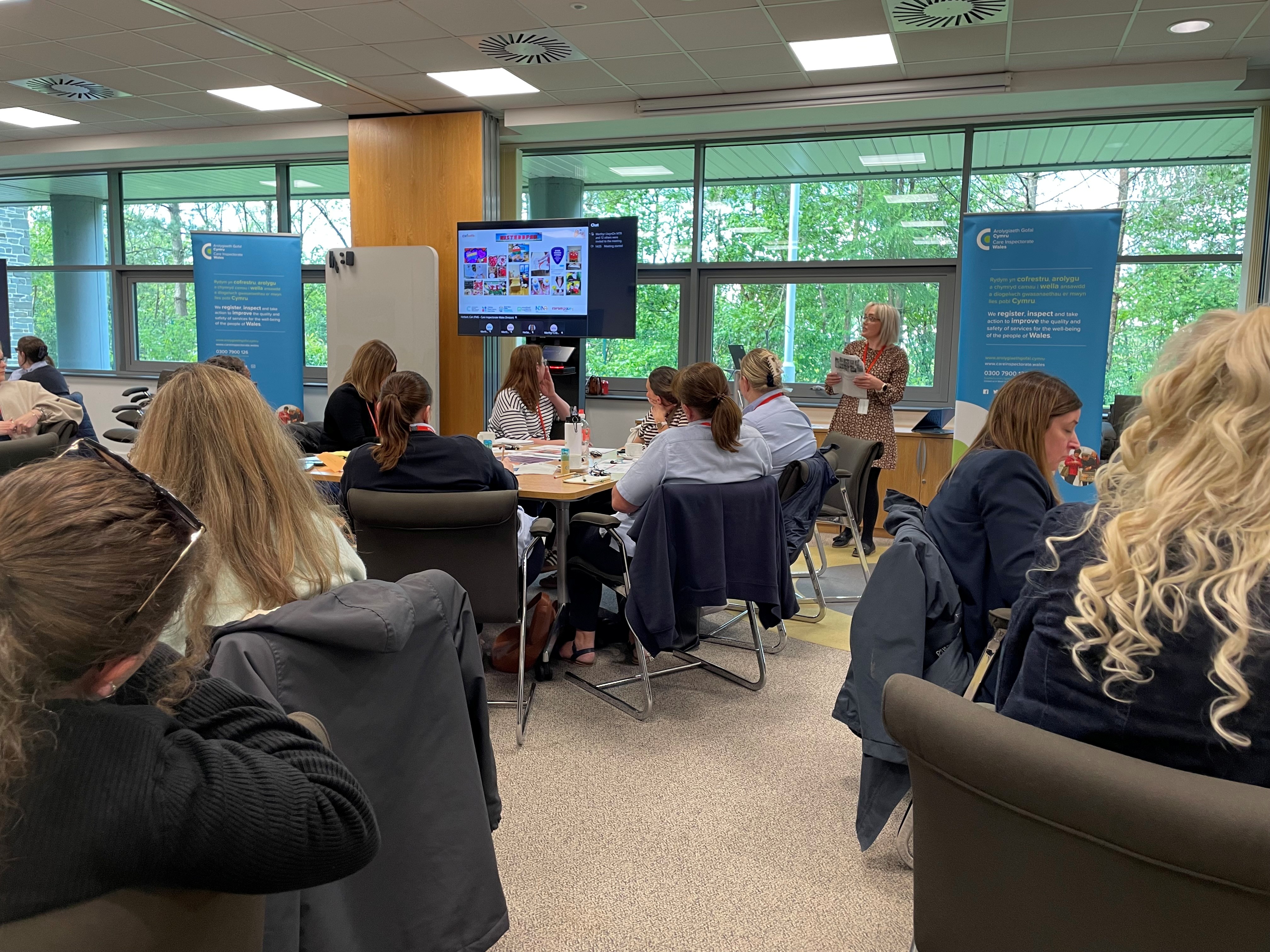
During spring 2026, we held three childcare and play provider events across Wales, welcoming over 150 delegates to sessions in Llandudno and Merthyr Tydfil. We would like to thank everyone who attended and took the time to share their feedback with us.
We had some brilliant conversations during the events, and we want to make sure everyone, whether you were there or not, has access to the key information we shared on the day. This page sets out the key topics we covered so all providers can access the same information.
Updates to the inspection framework
We shared details of the changes we are making to the childcare and play inspection framework. The changes are designed to make our inspection reports clearer, more streamlined and more relevant to the work you do every day.
What is changing
The updated framework will be built around three themes:
- Well-being and care
- Play, learning and development
- Leadership and management
This replaces the previous structure and brings a sharper focus on what matters most to children and families.
Updated key questions
We are also developing a draft set of key questions for inspections. These are still subject to change, but this is what inspectors may consider under each theme:
Well-being and care
- To what extent do children feel safe, happy, comfortable, and included?
- To what extent are children listened to, and their opinions valued?
- How well do children interact and develop relationships?
- How well do practitioners know the children and meet their individual needs?
Play, learning and development
- How well do children develop, learn, and become independent?
- How well do practitioners promote children's play, learning, and development?
- How well do practitioners create an effective indoor and outdoor environment?
Leadership and management
- How well are children safeguarded?
- How effective is leadership?
- How effective are self-evaluation and improvement?
- How effective is the management of staff?
- How well do leaders ensure the safety and suitability of the premises and resources?
- How effective are partnerships?
Development timeline
Here is how the framework update will be rolled out:
- Spring/Summer 2026 - We are using the feedback you gave us at the events to help us develop the framework and supporting documentation
- Autumn 2026 - Pilot of the updated framework begins
- Winter 2026 – We will review and respond to pilot feedback
- Spring/Summer 2027 - The updated framework is introduced
We will keep providers updated at each stage. Your feedback is an important part of this process. If you have views to share, please contact us using the details at the bottom of this page.
Promoting the Welsh language in your setting
We covered how we inspect and promote the Welsh language through the Active Offer. We were also joined by colleagues from Cwlwm, who presented on the Welsh Promise, a practical recognition scheme for settings committed to developing their Welsh language offer.
The Active Offer
Registered providers are expected to actively promote the Welsh language in your setting. The Active Offer means providing a service in Welsh without someone having to ask for it - anticipating, identifying, and meeting the Welsh language and cultural needs of children and families.
During inspections, CIW assesses providers against three levels:
- Providing the Active Offer - The service provider anticipates, identifies, and meets the Welsh language and culture needs of people.
- Working towards the Active Offer - The service provider makes an effort to promote the use of the Welsh language and culture or is working towards a bilingual service.
- Not providing the Active Offer - The service provider is not meeting the Welsh language and culture needs of people and this requires improvement.
Read more about the Active Offer in health and social care in the More Than Just Words five-year plan 2022 to 2027.
The Welsh Promise
The Welsh Promise is a practical scheme run by Cwlwm that helps settings grow their Welsh language offer step by step. It covers four areas:
- Welsh language development - Supporting children and staff to use Welsh confidently, with leaders actively promoting Welsh language and culture
- Welsh within the environment - Making sure Welsh is seen and heard, with bilingual signage and Welsh-appropriate resources
- Engaging with families - Communicating in Welsh where possible and making information available bilingually
- Bilingual paperwork - Promoting Welsh language opportunities through planning and documentation
Settings that complete the Welsh Promise receive recognition from the Welsh Language Commissioner. Here is what some settings have said:
"I found completing the bronze Welsh Promise very rewarding and enjoyable. I'd definitely recommend signing up to it if you are struggling to introduce and use Welsh in your practice." Abigail, childminder, Caerphilly
"Undertaking the Welsh Promise has been a positive thing within our setting. We have welcomed more families as a result." - Yasmin Matthews, Manager, DVLA Day Nursery
To find out more or sign up, visit the Cwlwm Welsh Language Support Co-ordinators webpage.
Your notification duties
We also used our events to recap notification duties under Regulation 31 of the Child Minding and Day Care (Wales) Regulations 2010, which sets out your legal duty to notify CIW when certain events occur at your setting.
This includes changes to personnel, changes to the type of care provided, and a range of incidents affecting child welfare, including safeguarding matters. Notifications should be made in advance where possible, or within 14 days of the event occurring.
We know safeguarding notifications can sometimes feel complex, so we have published a notifications relating to safeguarding guide (PDF) to help you understand exactly what needs to be reported and when. This covers the specific scenarios covered under Schedule 4 paragraphs 8, 9 and 10, including allegations of serious harm or abuse, events affecting suitability, and other significant events affecting child welfare.
Something to look out for - voluntary notifications
We know there are sometimes things you want to tell CIW about but there is no notification category that lets you do this, so we are considering adding some voluntary notifications. These are not required under the regulations but may be helpful for us to know about e.g. if you are taking the children out for the day or have an event such as a concert or sports day. We asked people at the events if they thought these were a good idea and most people welcomed this as an option. Options may include:
- Temporary closure of your service
- Day trips
- Staff training or INSET days
- Holidays (childminders)
- Building works or repairs
- Illness
- Any other relevant information
We will use your feedback to help us decide whether to introduce voluntary notifications and to think about the things that would be most useful to include. We will keep you updated as we work on this.
Improvements to online notifications
We are updating our online notifications system to make it simpler to use. You will notice clearer help text, more drop-down options, and specific questions to guide you through each type of notification.
Your event feedback
A huge thank you to everyone who attended one of our spring 2026 events and took the time to complete our feedback survey. 92 of you responded, and we have read every comment.
The feedback was overwhelmingly positive! 99% of respondents rated the events Excellent or Good, and 100% said attending was a good use of their time. On a scale of 1 to 10, you gave us an average score of 9.04 out of 10 for likelihood to recommend, which means a lot to us.
You told us the sessions were practical and informative, particularly around notifications, and many of you said having a CIW inspector at each table made a real difference - giving you the chance to ask questions in a relaxed, non-inspection environment. Networking with other providers was also highlighted as a real highlight.
"To be able to chat and ask questions in a non-inspection environment was such a success."
"These events help to break down the stigma of CIW and inspectors being scary and trying to look for fault."
We also heard that travel time and distance can be a barrier, particularly for those coming from rural areas or further afield, and that weekday events are not always easy to attend due to staffing pressures. We will take both of those points into account when planning future events.
We are looking forward to welcoming more of you at upcoming events. Keep an eye on the bulletin for dates and details.